Full Coverage Bras: What the Term Means, When They Help and How They Differ From Minimizers
Some mornings you want a bra that you can put on and then forget about entirely. No checking the neckline every time you bend down, no adjusting a strap in the middle of a meeting, nothing peeking over the top of your shirt. For many people, that is the appeal of a full coverage bra. The term turns up on almost every bra label, though, and it is easy to confuse with a minimizer, which looks similar on the hanger but is designed for a different purpose. This guide sorts out what full coverage actually means and when it is the right choice.
What is a full coverage bra?
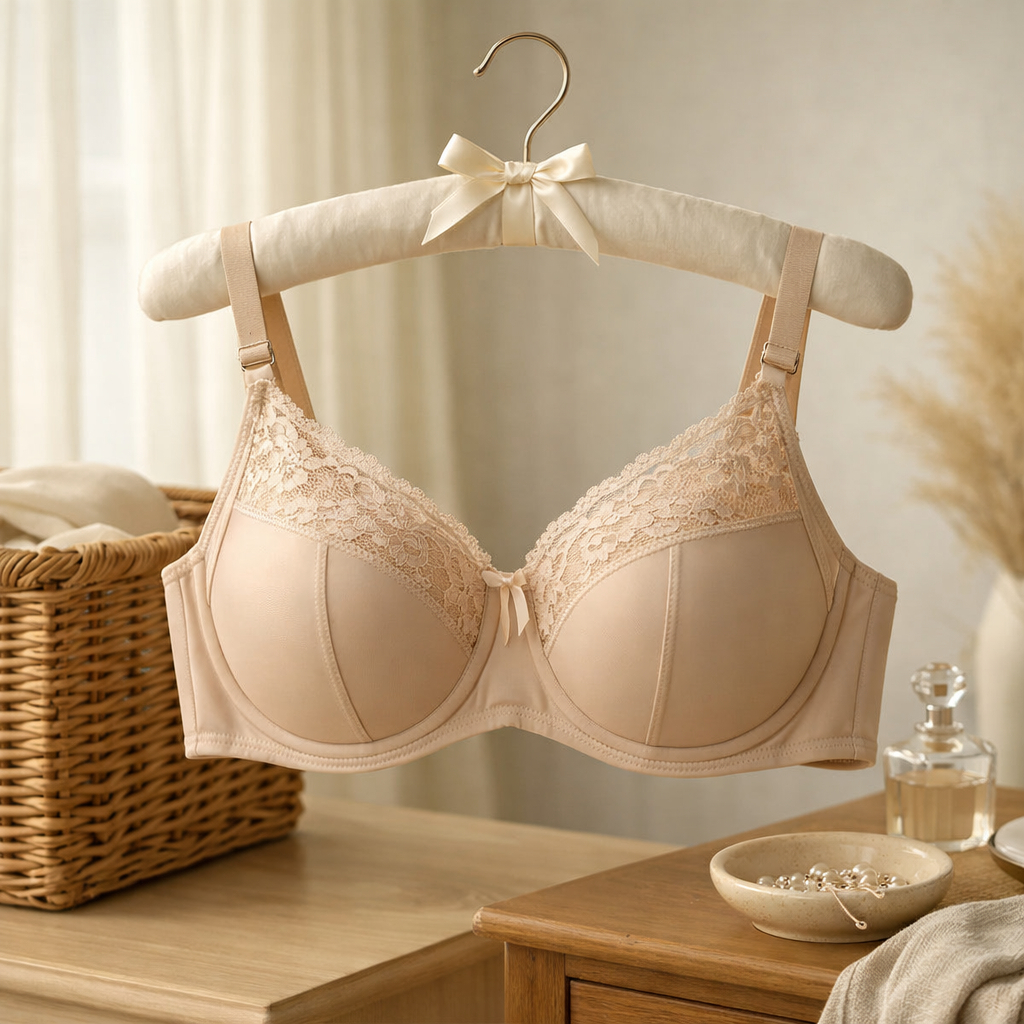
A full coverage bra has cups that enclose most or all of the breast. Compared with demi, balconette or plunge styles, the cups come up higher at the top edge, reach farther toward the underarm at the sides and usually have a higher center between the cups. The result is that very little sits outside the cup, and the bra stays secure under most necklines and during everyday movement.
There is no industry-wide measurement that defines full coverage. It is a description of cup shape rather than a technical standard, so one maker’s full coverage cup may sit slightly lower than another’s. The common thread is that the cup aims to contain rather than to reveal or lift upward.
How it compares with other cup shapes
| Cup style | Top edge | Coverage | Typical purpose |
|---|---|---|---|
| Full coverage | High, close to the top of the breast | Most or all of the breast | Security, everyday wear, higher necklines |
| Demi | Cut lower across the top | Roughly half to three quarters | Lower, wider necklines |
| Balconette | Low and fairly horizontal | Partial, with lift from below | Square and wide necklines |
| Plunge | Angled down toward a low center | Partial, open at the center | V-necks and deep necklines |
If you want to see how the lower-cut styles compare with each other, the guide to balconette, plunge and demi bras goes through them in detail.
How full coverage bras are built
Full coverage describes the cup, but the way the cup is made varies a lot. You will see the label on many different constructions:
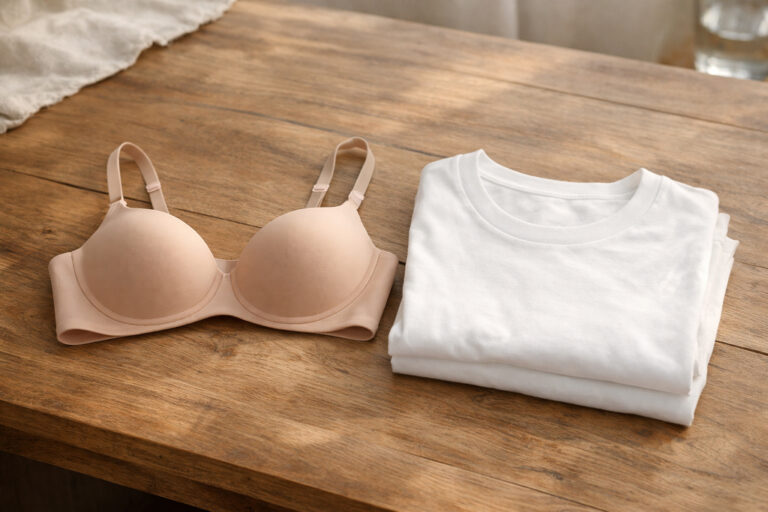
- Molded full coverage cups give a smooth, rounded outline and often double as t-shirt bras.
- Seamed full coverage cups, cut from two or three pieces, are common in fuller cup sizes because seams can shape and support more precisely.
- Unlined full coverage cups in firm fabric or lace offer coverage without foam, which some people find cooler and more natural in shape.
- Wired or wireless, depending on how much structure you want. A wireless full coverage bra relies on its band and side panels for support; the explainer on wireless bras covers how that works.
Because the cups are larger, many full coverage bras also have wider sides and a deeper band, and often wider straps. All of those help spread pressure and keep the cups in place.
When a full coverage bra helps
Full coverage is not about any particular size or body type. It is useful whenever you want security and a contained shape. Common situations include:
- Everyday wear when you want something reliable that does not need adjusting.
- Higher necklines and fitted tops, where a high, smooth cup edge avoids lines across the chest.
- Active days involving bending, lifting or carrying children, where lower cups might shift. For actual exercise, a sports bra is still the better tool.
- Fuller cup sizes, where many people find that a cup enclosing everything feels more secure. That is a common preference rather than a rule; plenty of people with fuller busts prefer balconettes.
- Sheer or light-colored tops, where a smooth, high cup in a shade near your skin tone is less visible.
They are less useful under deep V-necks, wide boat necks or square necklines, where the high cup edge may show. That is where demi, balconette and plunge styles come in.
Full coverage vs minimizer
This is the comparison that causes the most confusion. Minimizer bras almost always have full coverage cups, so they look similar. The difference is in what they are designed to do.
A full coverage bra is designed to enclose. It holds you in a rounded, natural shape and does not set out to change how you look in clothes.
A minimizer bra is designed to reduce forward projection. Its cups are typically cut to distribute tissue more toward the sides and spread it over a wider, flatter area, so that the bust looks less prominent in profile. People often choose one so that button-front shirts close without gaping. How much difference a minimizer makes varies a lot between designs and between people, so treat any specific claim on a label with some caution.
| Full coverage bra | Minimizer bra | |
|---|---|---|
| Main goal | Enclose and secure | Reduce how far the bust projects |
| Cup coverage | High | High, usually full coverage |
| Shape it creates | Rounded, close to natural | Flatter and wider in profile |
| Padding | Varies, from none to molded foam | Usually little or none |
| Often chosen for | Everyday comfort and security | Button-front shirts and fitted jackets |
In short: every minimizer is a full coverage bra of a sort, but most full coverage bras are not minimizers. For a closer look at how minimizers work, and how they compare with their opposite, read the guide to push-up and minimizer bras.
Full coverage bra fit checks
Because the cup covers so much, fit problems show clearly. These are the main ones to look for:
- Wrinkles or empty space at the top of the cup. The cup is too large, or its shape is fuller at the top than you are. Try a smaller cup or a different cup shape.
- Pressure or a ridge at the top edge. The cup is too small. Go up a cup size and keep the band the same.
- Wire sitting on tissue at the sides. In a wired full coverage bra, the wire should sit behind the breast tissue at the sides, not on it. If it presses, the cup may be too small or too narrow.
- A center that floats. The center panel should sit close to your chest. If it lifts away, the cups usually need more room.
- A band that rides up. The band should stay level. If it climbs, it is too loose, and the straps end up taking weight they should not.
If several of these sound familiar, the full checklist in signs your bra does not fit walks through each one, and sister sizes explains how to adjust band and cup together.
Any pain that does not go away when you take a bra off, or any change you are unsure about, is something to raise with a doctor rather than solve with a new bra.
Straps, band and sizing details
A full coverage cup holds more fabric than a lower-cut style, so the parts around it matter. A few details are worth checking before you settle on one:
- Strap position. On many full coverage bras, the straps attach toward the outer edge of the cup. If they tend to slip off your shoulders, look for straps set closer together at the back, or a convertible design you can wear crossed.
- Strap width. Wider or cushioned straps spread pressure across the shoulder. They should still be adjusted so the band, not the straps, carries most of the weight.
- Band depth and hooks. A deeper band with two or more rows of hooks tends to stay level more easily under a larger cup.
- Your usual size may shift. Because full coverage cups are cut deeper, some people find their usual cup size feels roomier in a full coverage style than in a plunge. Try both your usual size and one cup down before deciding.
Is full coverage old-fashioned?
Full coverage has a reputation as the plain, practical option at the back of the drawer, and that reputation is mostly out of date. The style now comes in lace, bright colors, smooth molded versions and soft wireless ones. The cut is about how much of you the cup encloses, not how the bra looks. If a full coverage bra is the one you forget you are wearing, that is a good reason to own a few.
Caring for full coverage bras
Full coverage bras often have molded cups or wider bands, and both last longer with gentle care. Wash in cool water by hand or in a mesh bag on a gentle cycle, reshape the cups while damp, and air-dry. Avoid folding a molded cup inside the other one when you store it. Rotating between two or three bras gives the band elastic time to recover between wears.
Where to go next
For a smooth, seam-free version of the same idea, read about t-shirt bras. To see how full coverage fits into the full range of bra shapes, browse the overview of types of bras.