Types of Bras: A Guide to 20 Common Styles and What Each One Does
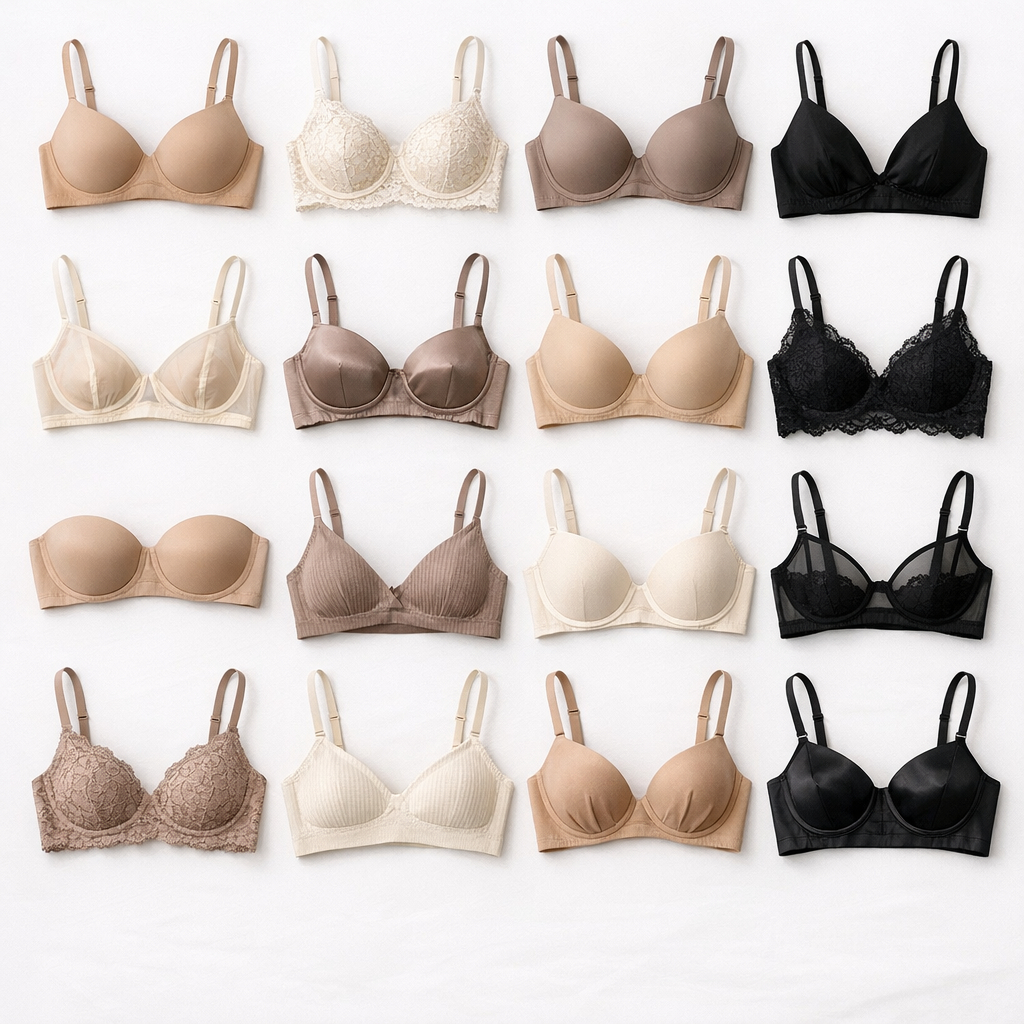
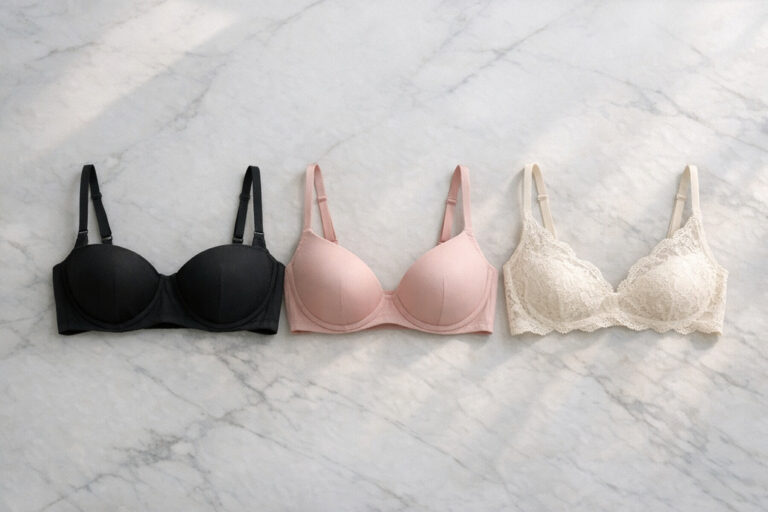
Open any drawer that has been filled over a few years and you will probably find a small museum of decisions: one bra bought for a particular top, one that came free with nothing but regret, one that has quietly become the only thing you reach for. Most of us learn the names of bra styles one at a time, usually when a shop label uses a word we have never seen before. This guide puts the common types of bras in one place, grouped by what each style is actually built to do, so the next unfamiliar label means something.
A quick note on scope. This is a map, not a deep dive. Several of these styles have their own full guides on the site, and I link to them as they come up. Style names also are not standardized: two makers can use the same word for slightly different cuts, so treat every definition here as the usual meaning rather than a legal one.
How to think about the types of bras
Almost every bra is a combination of four choices, and the style name usually describes just one of them:
- Cup cut — how much of the breast the cup covers and at what angle (full, demi, balconette, plunge).
- Cup construction — seamed fabric, molded foam, padding, or soft unlined fabric.
- Support structure — underwire or wireless, and how much work the band does.
- Straps and closure — standard, convertible, racerback, strapless, back or front fastening.
That is why a single bra can be several things at once: a wireless, molded, racerback T-shirt bra is a perfectly ordinary item. Once you see the four layers, the vocabulary stops feeling random.
Cup cuts: how much coverage, and where
1. Full coverage
The cup encloses most or all of the breast tissue, with a higher neckline and usually a taller center gore (the piece between the cups). It is the everyday workhorse for many people and often the easiest to fit because nothing spills over the top edge. The full coverage bra guide covers how it differs from a minimizer.
2. Demi cup
“Demi” means half. The cup is cut lower, typically covering somewhere between half and three-quarters of the breast, with straps set toward the outer edge. It suits lower necklines but gives a little less containment than a full cup.
3. Balconette
Also called a balcony or shelf bra. The top edge of the cup runs almost horizontally across, and the straps sit wide. The effect is lift rather than pushing inward, and it works under square and wide necklines.
4. Plunge
The cups are angled and the center gore is very low, forming a deep V. It is the style for V-necks and wrap tops where a standard gore would show. Balconette, demi and plunge get easily confused, so I compared them side by side in the balconette, plunge and demi guide.
Cup construction: what the cup is made of
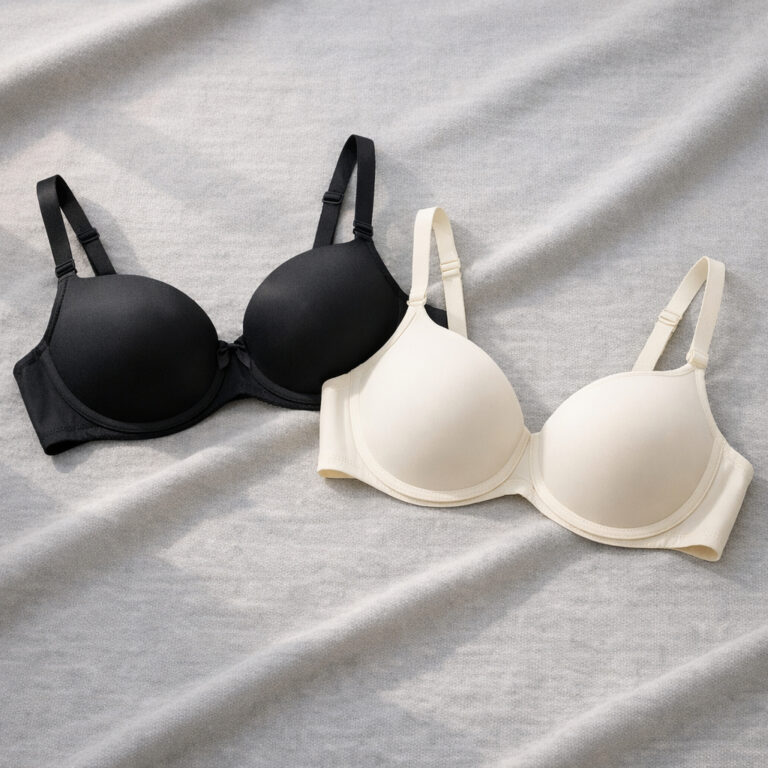
5. Molded (contour) cup
The cup is heat-formed into a fixed, seamless shape, usually with a thin foam layer. It holds its shape off the body, which gives a smooth line under clothing and can even out small differences between sides.
6. Seamed cup
The cup is sewn from two, three or more fabric pieces. Seams let a maker shape and direct the support precisely, which is why seamed cups are common in larger cup sizes. The trade-off is that seams can show faintly under thin fabric.
7. Unlined (sheer) cup
A single layer of fabric or lace with no foam. It is light and breathable and takes the shape of the wearer rather than imposing one.
8. Padded and push-up
Padding adds volume. A push-up places extra padding at the bottom and outer sides of an angled cup to lift and bring the breasts closer together. Its opposite number is the minimizer, which redistributes tissue to reduce projection. Both are explained in the guide to push-up and minimizer bras.
9. T-shirt bra
A name for a purpose rather than a construction: usually a molded, seam-free cup with smooth edges, designed to disappear under fitted knits.
Support structure: wires, bands and length
10. Underwire
A thin curved strip of metal or plastic sewn into a channel under each cup. It anchors the cup to the body and separates the breasts. Most of the styles above come in underwire versions.
11. Wireless (soft cup)
No wire; support comes from the band, the cup fabric, seams and sometimes molded foam or side panels. Comfort is the main reason people choose it, and modern wireless designs go well beyond what the term used to mean.
12. Bralette
A light, often unlined pullover or hook-back bra, frequently in lace, with minimal structure. It suits smaller cup sizes or days when you want very little support.
13. Bandeau
A simple tube of stretch fabric worn across the chest, with or without removable pads. It gives little support and is mainly a layering piece.
14. Longline
The band extends well below the cups, sometimes to the waist. The extra length spreads the support over a larger area, which some people find steadier, and it is often used under strapless or backless dresses.
Straps and closures
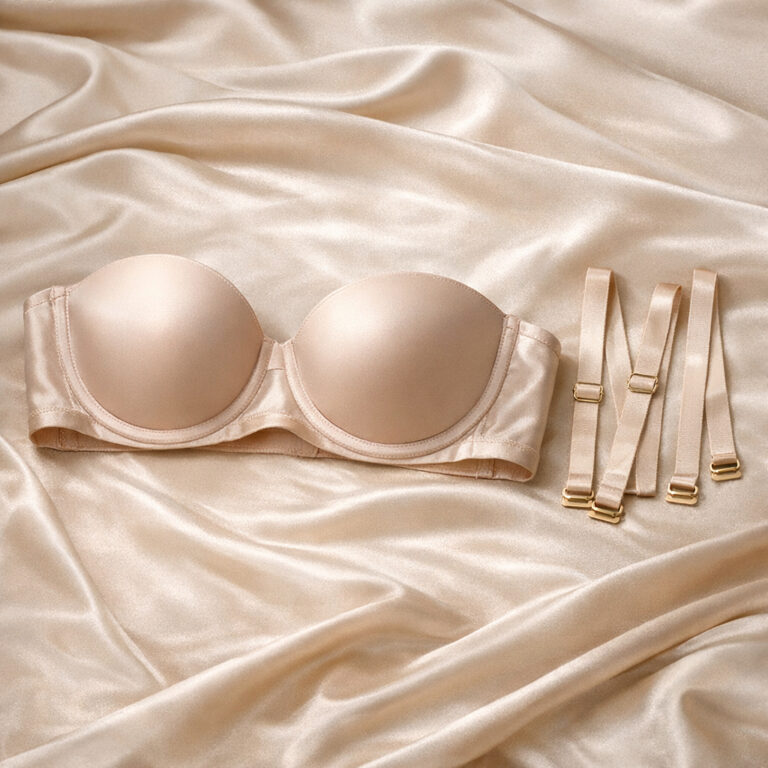
15. Strapless
No straps at all, so the band, wire and grip strips do all the work. How a strapless bra actually stays in place is a construction question in its own right; see the full guide to strapless and convertible bras.
16. Convertible (multiway)
Detachable straps that can be reattached in several configurations: standard, halter, criss-cross, one-shoulder or none at all.
17. Racerback
The straps meet between the shoulder blades in a V, Y or T. It keeps straps from sliding off narrow or sloping shoulders and hides them under racer-cut tank tops.
18. Front closure
The fastening sits at the center front instead of the back. It is easier for anyone who finds reaching behind difficult, and it leaves a smooth back. The catch is that the band length is fixed, with no hook columns to adjust.
Purpose-built bras
19. Sports bra
Designed to limit movement during exercise, either by compression (pressing tissue against the chest) or encapsulation (separate cups). Support levels are matched to activity; the sports bra guide explains the difference.
20. Nursing and maternity bras
Nursing bras have cups with clips or panels that open one-handed, usually with soft, stretchy fabric that accommodates size changes. Maternity bras are made for the changes during pregnancy. Both are covered in the sports and nursing section.
Comparison at a glance
| Style | What defines it | Typical use | Main trade-off |
|---|---|---|---|
| Full coverage | Cup encloses most tissue | Everyday wear | Can show at low necklines |
| Demi | Cup cut to about half or three-quarters | Lower necklines | Less containment |
| Balconette | Horizontal top edge, wide straps | Square and wide necklines | Straps can slip on narrow shoulders |
| Plunge | Very low center gore | V-necks, wrap tops | Less side coverage |
| Molded / T-shirt | Seamless pre-shaped cup | Fitted, thin tops | Fixed shape may not match yours |
| Seamed | Cup sewn from several pieces | Precise shaping, larger cups | Seams can show |
| Push-up | Graduated padding, angled cup | Adding lift and volume | Bulkier, warmer |
| Minimizer | Cup that reduces projection | Button-front shirts | Shape is flatter, not smaller |
| Wireless | No underwire | Comfort, lounging | Less separation |
| Bralette | Light, minimal structure | Low-support days, layering | Little support |
| Longline | Extended band | Spreading support, formal wear | Can ride up if the band is wrong |
| Strapless | No straps; band does the work | Off-shoulder and strapless outfits | Needs a very firm band |
| Convertible | Detachable, re-routable straps | Halter and one-shoulder tops | More hardware to manage |
| Racerback | Straps meet between shoulder blades | Tank tops, sloping shoulders | Less strap adjustability on some |
| Front closure | Fastens at center front | Easy on and off | Band not adjustable |
| Sports | Compression or encapsulation | Exercise | Warm, snug for all-day wear |
Choosing among them
Start with the outfit or the activity, not the style name. Ask what the neckline needs (a low gore, a straight top edge, no straps), what the fabric of the top will reveal (seams, texture, edges), and how much support you want for the day. That narrows twenty styles to two or three.
Then remember that fit beats style every time. A balconette in the wrong band size will fail in ways no balconette in the right size would. If you have not measured in a while, begin with how to measure your bra size, and expect to adjust between styles: the same person can wear slightly different sizes in a plunge and a full cup, because the cut changes how much room the cup has.
Finally, a small rotation of three or four styles usually covers more ground than a drawer full of variations on one. A smooth everyday bra, something for low or unusual necklines, a strapless or convertible option, and a sports bra handle most wardrobes.
Where to go next
For the styles that confuse people most, read the comparison of balconette, plunge and demi bras. If you want to check whether your current bras fit before buying a new style, the guide to signs your bra does not fit walks through the band, cups and straps.