Balconette, Plunge and Demi Bras Compared: Cup Shape, Neckline and Use
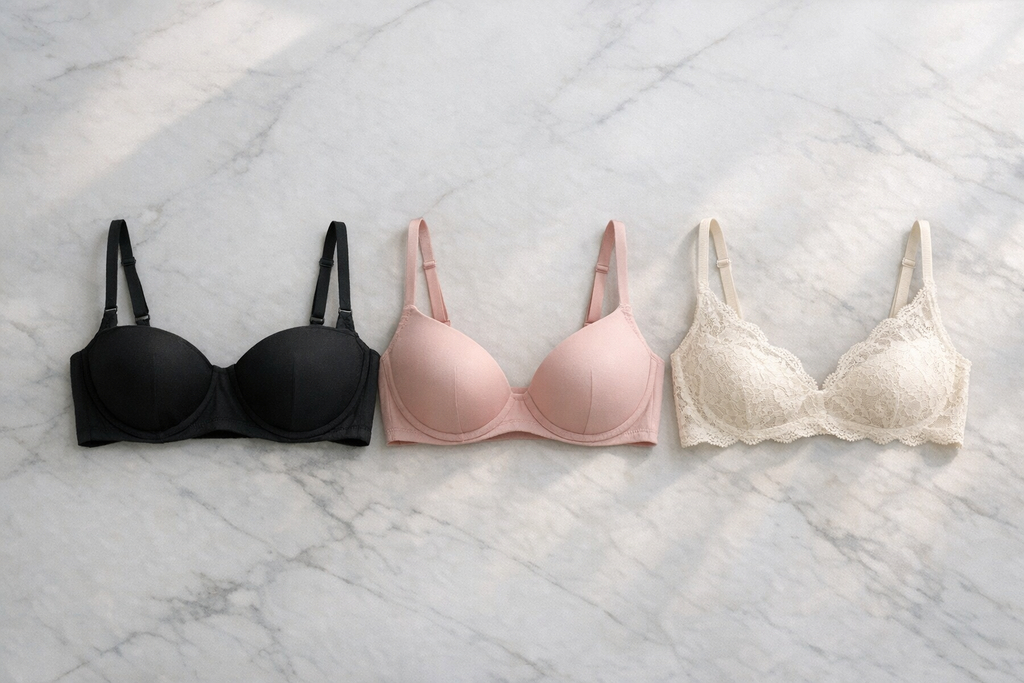
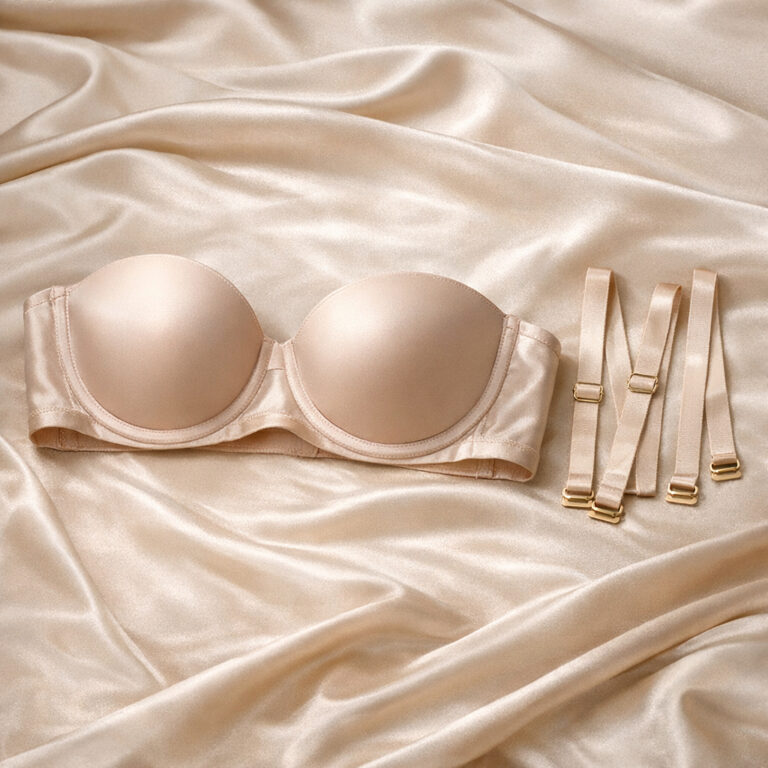
Hold three bras up by their center gores and the difference is obvious in a way no product description quite manages. One has a straight top edge running almost level across both cups. One dives into a deep V with barely any fabric in the middle. The third looks like a full-coverage bra someone trimmed down with scissors. These are the balconette bra, the plunge and the demi, and while they all sit lower than a full cup, they solve different problems. Mixing them up is the reason a lot of people end up with a bra that peeks out of exactly the neckline they bought it for.
The three cuts in one sentence each
- Balconette: a cup with a roughly horizontal top edge and straps set wide, giving lift and a rounded shape.
- Plunge: angled cups joined by a very low center gore, forming a deep V for low-cut fronts.
- Demi: a cup cut lower than a full cup, covering roughly half to three-quarters, with straps toward the outer edge.
The terms overlap at the edges, and different makers use them a little differently. Some call almost any low, wide cup a balconette; some sell a “demi plunge.” Use the definitions as a guide to what to look for, then judge each bra by its actual shape.
What is a balconette bra?
The name comes from a balcony, and the image is a fair one: the top of the cup forms a level ledge. A balconette bra is also sold as a balcony bra or, in older or more extreme versions, a shelf bra. The cup is usually shallower at the top than a full cup and is often seamed, with a vertical or diagonal seam that shapes the lower part of the cup and pushes the support upward rather than inward.
Two construction details set it apart:
- Wide-set straps. The straps attach toward the outer edge of the cups and run fairly straight up. That keeps them hidden under wide and square necklines, but it is also why balconette straps can slip off narrow or sloping shoulders.
- A medium-height center gore. Lower than a full cup, higher than a plunge. The cups sit a little apart rather than angling toward each other.
The result is lift and a rounded, forward shape. It is a natural partner for square necklines, sweetheart necklines, boat necks and off-the-shoulder styles that still leave room for straps.
Who tends to find it comfortable
Balconettes often suit people whose breast tissue is fuller at the bottom than the top, because the cup is fuller at the bottom too. If you have more fullness at the top, the straight top edge can cut in and create a ridge under clothing. That is a fit mismatch, not a size problem, and going up a cup size rarely fixes it.
What is a plunge bra?
A plunge bra is built around its center gore, which is cut very low, sometimes only an inch or two high. The cups are angled inward and usually narrower at the top, so the overall shape is a V. Straps are often set closer to the center than on a balconette.
The job of a plunge is simple: disappear under V-necks, wrap tops and low-cut fronts where a standard gore would show. Plunges come in every construction, from unlined lace to molded foam to lightly padded. They are less about adding shape and more about getting out of the way of the neckline.
Who tends to find it comfortable
Plunges often work well for people whose breasts sit close together or are fuller toward the center. If your breasts are set wider apart, the angled cups can leave a gap at the inner edge or push tissue awkwardly. A plunge with a very low gore also has less fabric holding the wires apart, so getting the band size right matters even more.
What is a demi bra?
“Demi” means half, and a demi cup is simply a cup cut lower than full coverage. Estimates of how much it covers vary between half and three-quarters, which tells you how loose the term is. The top edge is usually curved or slightly diagonal rather than straight, and the straps attach toward the outer edge of the cup.
Where a balconette has a distinctive horizontal edge and a plunge has a distinctive low gore, a demi is defined mostly by what it is not: it is not a full cup. Many demi bras are molded and smooth, which makes them a common choice as a lower-cut everyday or T-shirt bra.
Who tends to find it comfortable
Demi cups suit a wide range of shapes because they are the least extreme of the three. The main thing to watch is the top edge: on fuller cup sizes, a cup cut too low can let tissue spill over the top, which is a sign you need either a larger cup or more coverage.
Side-by-side comparison
| Feature | Balconette | Plunge | Demi |
|---|---|---|---|
| Top edge of cup | Roughly horizontal | Angled, forms a V | Curved or slightly diagonal, lower than full |
| Center gore | Medium height | Very low | Low to medium |
| Strap placement | Wide, toward outer edge | Often closer to center | Toward outer edge |
| Shaping effect | Lift, rounded shape | Brings cups toward center | Moderate lift, less coverage |
| Best necklines | Square, sweetheart, boat, wide scoop | V-neck, wrap, low-cut front | Scoop, lower crew, most everyday tops |
| Common fit issue | Straps slipping; top edge cutting in | Gaps at inner edge if breasts are set wide | Spilling over top edge |
| Often suits | Fuller at the bottom | Close-set or center-full | Most shapes |
Matching the bra to the neckline
The fastest way to choose among the three is to put on the top first and look at where the fabric goes:
- Is the neckline deep in the middle? A V-neck or wrap needs a low gore, so start with a plunge.
- Is it wide and straight across? Square and boat necklines want a level cup edge and wide straps, which is the balconette’s territory.
- Is it a moderate scoop? A demi will usually sit below it without fuss.
- Is it sheer or clingy? Construction matters as much as cut. A molded version of any of the three gives a smoother line.
If you are deciding between strap placements rather than cups, a convertible bra may solve the problem for several outfits at once; the guide to strapless and convertible bras explains the configurations.
Fit checks that apply to all three
The lower the cut, the more fit mistakes show. Run through these whenever you try one on:
- The band sits level all the way around and feels firm on the loosest hook.
- The wires, if any, sit flat against your ribs and enclose all the tissue at the sides, not on it.
- The gore lies against your sternum. In a plunge it is small, but it should still touch.
- The top edge lies smoothly. No gap you can slide fingers into, and no ridge where it presses in.
- The straps stay put when you raise and lower your arms; they should not be carrying most of the weight.
Expect your size to shift a little between styles. A balconette and a plunge in the same labeled size hold different volumes because the cups are cut differently, and some people go up or down a cup between them. Your band size usually stays the same. For a refresher on what each sign means, see signs your bra does not fit.
A note on padding
All three cuts come padded and unpadded. Padding is a separate choice from the cut: a padded plunge with graduated foam is close to a push-up, while an unlined balconette in lace is very light. If you are specifically after more lift or more volume, the guide to push-up and minimizer bras explains what padding does and does not change.
The same goes for seams. A seamed balconette shapes the cup through its panels and adapts to more breast shapes, but the seams may show under a fine knit. A molded version gives a smooth surface but has a fixed shape, so it either matches yours or it doesn’t. If one version of a cut never seems to fit, try the other construction before giving up on the style entirely. It is often the cup build, not the cut, that was wrong for you.
Where to go next
For the full range of styles beyond these three, browse the guide to types of bras. If your size feels off in every cut you try, go back to basics with how to measure your bra size.