Push-Up and Minimizer Bras: How Each Changes Shape, and When to Use One
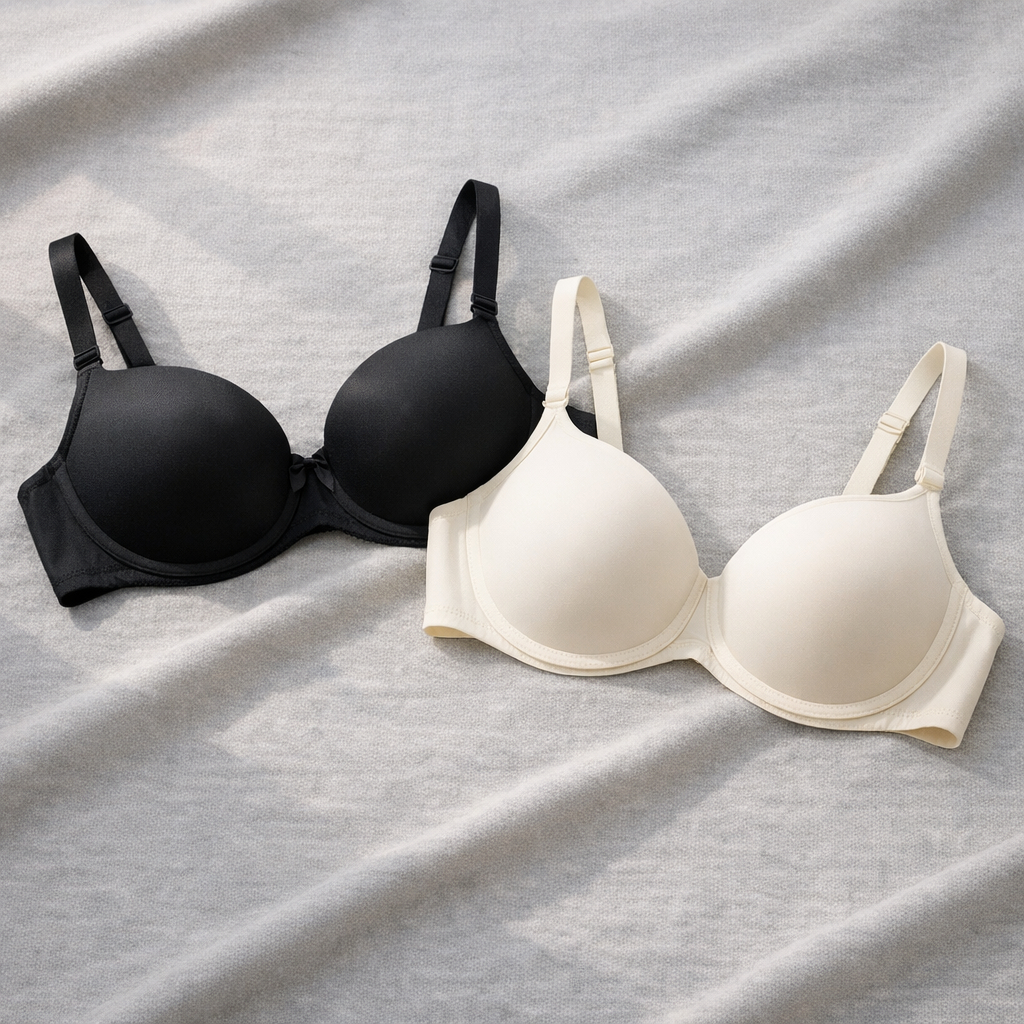
A button-front shirt that gapes between the second and third buttons, and a scoop-neck dress that looks flat and shapeless on you no matter how you adjust it: two different complaints, and two different bras that people reach for to fix them. The push up bra adds lift and volume; the minimizer reduces how far the bust projects forward. They sound like opposites, and in construction they nearly are. Both are tools for changing how clothes fall rather than everyday essentials, and both work best when you understand exactly what they do and what they cannot do.
What a push up bra does
A push-up bra changes shape in two directions at once: upward and toward the center. It does this with padding placed unevenly inside the cup and with a cup cut that encourages the movement.
Graduated padding
The defining feature is padding that is thicker at the bottom and outer sides of the cup and thin or absent at the top and inner edge. That wedge of foam lifts the breast from below and nudges it inward. Some push-ups use fixed, molded foam; others have a pocket with a removable pad, sometimes called a cookie, so you can adjust the effect or take it out entirely. Gel- or air-filled inserts exist too, and they work on the same principle.
An angled, lower cup
Push-up cups are usually cut in a demi or plunge shape, with the top edge angled down toward a low center gore. The lower gore lets the cups sit closer together, and the angled top edge leaves room for the lifted shape. Straps are often set a little closer to the center to support that angle. If those cut names are new to you, the comparison of balconette, plunge and demi bras explains them.
Firm structure
Most push-ups use underwire, because the wire anchors the cup while the padding pushes against it. Wireless push-ups exist and rely on firmer foam and a stronger band instead; the lift tends to be gentler.
What a minimizer does
A minimizer works in the opposite direction. Rather than adding volume or projecting the bust forward, it redistributes breast tissue so that it sits closer to the body and spreads slightly more toward the sides. The goal is a lower forward profile, which helps shirts button smoothly and makes some knit tops hang straighter.
How it is built
- Full-coverage cups that enclose more tissue, with higher edges at the top and sides.
- Seamed or firm, non-stretch cup fabric that shapes the breast into a rounder, flatter profile instead of a pointed one.
- Side support panels inside the cup or along the sides that guide tissue toward the center front and keep it from spreading under the arm.
- Wider straps and a sturdy band, since minimizers are made mainly in fuller cup sizes.
Marketing for minimizers often quotes a specific reduction in measurement. Those figures depend entirely on the design and the person, and I have not seen independent measurements to support any particular number, so treat them as claims rather than facts.
What it does not do
A minimizer does not make your breasts smaller, and it should not be worn in a smaller cup size to try. It changes shape, not volume. The tissue has to go somewhere, which is why a minimizer can look wider from the front even as it looks flatter from the side. A minimizer that is too small will dig in, spill over the edges and press tissue under the arm, which defeats the purpose.
Side-by-side comparison
| Feature | Push-up | Minimizer |
|---|---|---|
| Main effect | Adds lift and volume, moves toward center | Reduces forward projection |
| Padding | Graduated, thicker at bottom and sides | Usually none or a thin smoothing layer |
| Cup cut | Demi or plunge, angled top edge | Full coverage |
| Center gore | Low | Medium to high |
| Typical size range | Most common in smaller to mid cup sizes | Most common in fuller cup sizes |
| Good under | Lower necklines, fitted dresses | Button-front shirts, structured jackets, fine knits |
| Trade-off | Bulkier, warmer, visible at some necklines | Can look wider from the front |
How to tell if a push up bra is the right tool
A push-up makes sense when you want a particular outfit to have more shape at the top, or when one side is noticeably smaller and a removable pad on that side alone would even things out. That second use is underrated: a push-up with removable pads is an easy way to balance an asymmetric bust.
It is a less good choice for all-day everyday wear if you find foam warm, or if you mainly want comfort and smoothness. A molded T-shirt bra without graduated padding gives a smooth line with far less bulk.
Fitting a push-up
- Fit the band first. It should be snug and level, just as with any bra.
- The breast should sit fully in the cup with the padding underneath, not on top of the padding. If tissue bulges over the top edge, the cup is too small.
- If the top of the cup gaps, the padding may be too thick for you; try removing the pad or choosing a lighter version.
- Because padding takes up space, some people need a different cup size in a push-up than in an unpadded bra. Try both your usual size and one up.
How to tell if a minimizer is the right tool
A minimizer is worth trying if shirts gape at the bust even when they fit everywhere else, or if you simply prefer a lower profile under fitted clothes. It is primarily a fuller-cup style, and many people find its higher coverage and side support comfortable on its own terms.
If the goal is mainly more containment and less movement, a well-fitted full coverage bra may do what you want without the reshaping. The two overlap a great deal; the minimizer just adds the internal shaping.
Fitting a minimizer
- Wear your true size. A smaller cup is not more minimizing; it is just tight.
- Check under the arm: the side panels should gather tissue forward, and the wire should sit behind the breast, not on it.
- Look from the side in a fitted top. You should see a smoother, lower profile, not a ridge at the top edge.
- If the straps are digging in, the band is probably too loose and the straps are carrying weight they shouldn’t.
Under different clothes
It helps to think about the outfit before choosing either style, because each one shines in some clothes and works against you in others.
- Button-front shirts and blouses: the classic minimizer job. A lower profile lets the placket lie flat. A push-up usually makes gaping worse.
- Fitted knit tops: a minimizer gives a smooth, straighter drape. A push-up can show its padded edge through thin knit, so a molded cup without graduated padding is often the better middle ground.
- Lower scoop and V necklines: a push-up’s angled cup and low gore sit below the neckline. A minimizer’s higher coverage is likely to show.
- Structured jackets and dresses with set bust shaping: pick whichever brings you closer to the garment’s own shape. A dress with shaped bust seams that sit empty may look better with a little added volume; one that pulls across the front may look better with less.
Caring for padded and shaped cups
Both styles depend on their internal structure, so care matters. Foam padding can crease or lose its shape if it is folded, wrung or tumble-dried, and the side panels in a minimizer rely on firm fabric that heat and harsh agitation will soften. Wash on a gentle cycle in a mesh bag or by hand, press water out rather than twisting, and dry flat. Store push-ups with the cups nested together instead of folding one cup into the other. If a pad is removable, take it out to wash and put it back once both are dry.
A word on comfort
Neither style is meant to hurt. Pressure marks that fade within a few minutes of taking a bra off are normal; lasting soreness, pain or skin irritation are not, and are a reason to change the fit or see a doctor rather than to persist. Neither a push-up nor a minimizer changes anything about your body’s health, positively or negatively. They are clothing that shapes how other clothing falls.
If every push-up or minimizer you try feels wrong, the problem may be the starting size rather than the style. Measuring again with how to measure your bra size is a good reset.
Where to go next
To see how these two fit among all the other styles, read the guide to types of bras. If you are working out which size to try in a new style, the guide to bra sister sizes explains how band and cup trade off.