Strapless and Convertible Bras: How They Stay Up and How to Wear Them
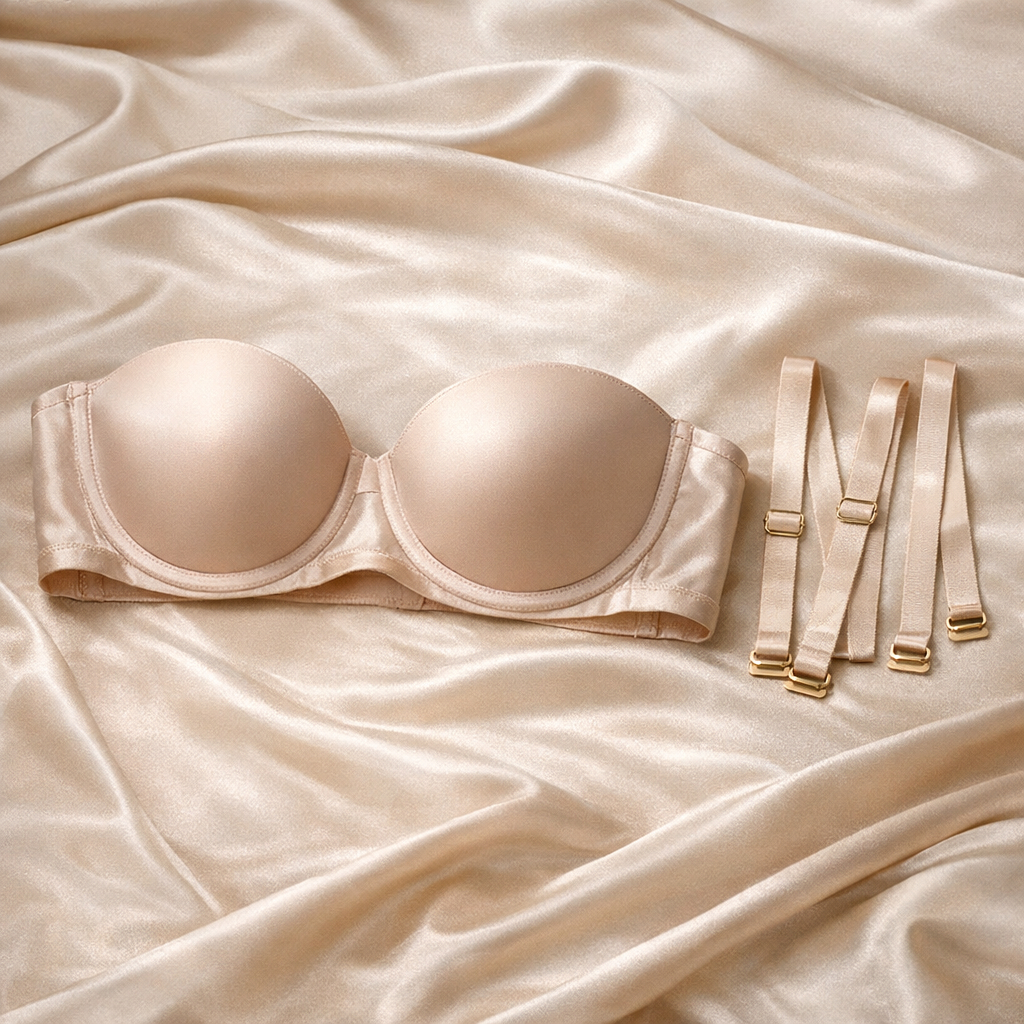
The first time I took apart an old strapless bra to see why it had spent an entire evening sliding south, the answer was sitting in plain sight: a soft, stretched-out band, a grip strip that had lost its tack, and side panels with no boning at all. Nothing about it was designed to stay up. A good strapless bra is one of the more interesting pieces of engineering in a lingerie drawer, because it has to do the job of two straps with nothing but a band. Once you understand how that works, choosing one gets much easier, and so does making sense of the convertible bras that often double as strapless ones.
How a strapless bra stays up
In an ordinary bra, the band does most of the supporting, and the straps hold the top of the cups in position and take some of the load. Take the straps away and the band has to do everything: hold the cups up, keep them against the body, and resist the steady downward pull of gravity and movement. Designers solve that with four tools, usually in combination.
1. A firmer, wider band
The band is the foundation. Strapless bands tend to be wider than those on everyday bras, often with three or four hook-and-eye columns rather than two, and are cut from firmer elastic. A wider band spreads the pressure over a larger area and grips more of the torso, which makes it less likely to roll or slide. This is also why a strapless bra should fit snugly on the loosest hook when new: if the band can creep, the whole bra will.
2. Silicone grip strips
Look inside most strapless bras and you will see thin lines, dots or zigzags of silicone along the top edge of the band, the top of the cups, the bottom edge of the band, or several of these places. Silicone creates friction against skin, so the fabric resists sliding without needing to be tighter. The grip works best on clean, dry skin; lotion or oil underneath reduces it noticeably, and over many washes the silicone can wear smooth.
3. Boning in the side seams
Boning is a narrow, flexible stay, usually plastic or spiral steel, sewn into a channel in the side panels, the same idea as in a corset or the bodice of a strapless dress. It stops the side of the band from buckling or folding over, keeps the fabric standing vertically, and helps the top edge stay flat against the body. Bras without boning in the sides are much more prone to the top edge rolling down.
4. Longer or reshaped underwire
Many strapless bras use underwires that extend further up at the sides or are shaped to wrap more of the way around the cup. Because there is no strap to anchor the top of the cup, the wire has to hold the cup’s shape and keep it in contact with the body on its own. Some designs also set the cups at a slightly different angle so that the weight sits closer to the band.
Cup construction matters too. Most strapless bras use molded cups, sometimes lightly padded, because a stiff cup holds its shape without strap tension. Unlined fabric cups tend to collapse at the top once the straps are gone.
Strapless bra variations
| Variation | How it is built | Where it helps | Watch out for |
|---|---|---|---|
| Standard strapless | Wide band, wire, side boning, grip strips | Most strapless and off-shoulder tops | Band must be firm from day one |
| Longline strapless | Band extends toward the waist | Larger cup sizes, formal dresses, long wear | Can show at a low back or cut-out |
| Bustier | Longer, structured body, often with more boning | Under fitted bodices, as a top layer | Warm; needs accurate torso length |
| Bandeau | Stretch tube, little or no structure | Light layering, small cup sizes | Little real support |
| Adhesive (stick-on) cups | Silicone or fabric cups with adhesive, no band | Backless and very low-cut outfits | Minimal support; limited reuses |
Adhesive cups deserve one extra word: they are not really a bra in the structural sense, because there is no band to carry anything. They are a solution for outfits where nothing else can go, and they work best for lighter support needs. If your skin reacts to adhesives, test a small area first, and see a doctor if irritation persists.
Convertible bras and their strap configurations
A convertible or multiway bra has detachable straps with small hooks or clips that fasten to loops at the top of the cups and on the back of the band. Most are built on a strapless base, with the same firm band and grip strips, so you can wear them with no straps at all. The value is flexibility: one bra for a halter top, a one-shoulder dress and a tank top.
| Configuration | How the straps attach | Works under | Practical notes |
|---|---|---|---|
| Standard (over the shoulder) | Each cup to the same-side back loop | Most everyday tops | The baseline; compare fit in this setting first |
| Criss-cross | Each cup to the opposite back loop, forming an X | Tops with wide or sloping shoulders | Pulls straps inward, so they slip less |
| Halter | Both straps from the cups up and around the back of the neck | Halter necklines | Puts some load on the neck; keep the band doing the work |
| One-shoulder | A single strap from one cup to the opposite back loop | Asymmetric and one-shoulder tops | Choose the side the garment covers |
| Racerback | Straps over the shoulders, joined between the shoulder blades by a clip or crossed | Racer-cut tank tops | Some bras include a separate clip for this |
| Strapless | Straps removed | Strapless and off-shoulder outfits | Relies entirely on the band and grip |
Not every convertible bra supports every configuration; it depends on how many loops the band has and where they sit. Check that the loops are reinforced, because they carry the whole strap load, and that the strap hooks close fully rather than resting open.
How to choose a strapless bra that works
Get the band right first
Because the band does all the work, a strapless bra usually needs to fit more firmly than your everyday bra. Many people find they do better going down one band size and up one cup size, which keeps the same cup volume on a tighter band; this is the sister-size idea explained in the guide to bra sister sizes. It is a common starting point, not a rule. If the band digs in painfully or leaves you short of breath, it is too small.
Check the cups without straps
Try it on with the straps removed and move around: raise your arms, bend forward, sit down. The top edge of the cups should lie flat, without gaping or cutting in. Gaping means the cup is too big or the wrong shape; cutting in means it is too small. Then check that the center gore sits against your sternum, the same test as in any underwire bra.
Look at the construction
- Is there boning in the side seams? Press the sides to feel for it.
- Where are the grip strips, and is there more than one line?
- How many hook columns are there, and how wide is the band?
- Do the wires extend high enough at the sides to support the cup?
Consider a longline for long days
If you need to wear a strapless bra for many hours, or wear a larger cup size, a longline version spreads the pressure over more of the torso and tends to stay put better. Many people find it more comfortable across a long event than a narrow band worn very tight.
Wearing and caring for one
Fasten the band, then lean forward and settle each cup by hand before standing up, so the grip starts in the right place. Skip body lotion where the band and grip strips sit. A quick tug down at the back now and then keeps the band level, which in turn keeps the front up.
Silicone grip and boning are both sensitive to heat, so hand-washing and air-drying flat will keep a strapless bra working longer; the guide to how to wash bras has the details. Store molded strapless cups nested or flat rather than folded in half, so the wire and cup keep their shape.
Where to go next
To see how strapless and convertible bras fit among the other styles, read the overview of types of bras. If the band size is the sticking point, start with how to measure your bra size.