Wireless Bras: How They Support Without Wires and What to Look For
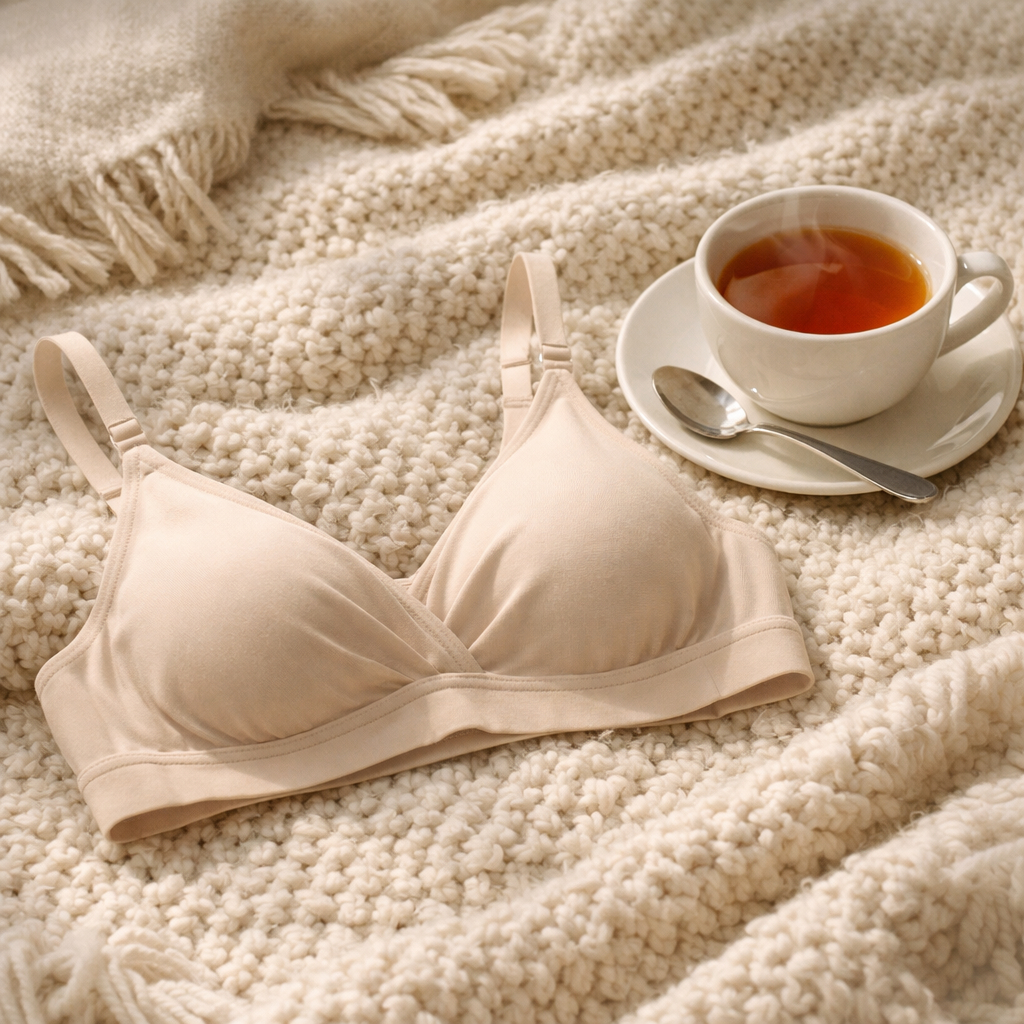
Most of us know the moment: you get home, unhook your bra before you have even put your bag down, and feel the pressure line from the underwire fade along your ribs. It is one of the most common reasons people start looking at a wireless bra. The usual worry follows straight after: without the wire, will anything actually hold? It can, but only if the bra is built to do the wire’s job in other ways. This guide explains how that works, so you can tell a well-constructed wireless bra from one that just looks soft on the hanger.
What the underwire actually does
To understand a wireless bra, it helps to know what the wire is for. An underwire is a thin, curved piece of metal or plastic sewn into a fabric channel under each cup. It does three things:
- It holds the bottom of each cup in a fixed shape, so the cup cannot collapse or fold.
- It anchors the cups against the ribcage and keeps them separated at the center.
- It transfers some of the weight of the cups into the band, which carries it around the body.
A wireless design has to achieve those same three things with fabric, seams and elastic. None of them is magic; each one is a construction choice you can look for.
How a wireless bra creates support
The band does more of the work
In any bra, the band supplies most of the support. In a wireless bra, it supplies even more, because there is no rigid frame to share the load. That is why good wireless styles usually have a deeper band than their wired equivalents, sometimes with two or three rows of hooks at the back, and a firm elastic along the bottom edge. A band that stays level and snug is the foundation; if it rides up, nothing above it can hold properly.
Seamed cups
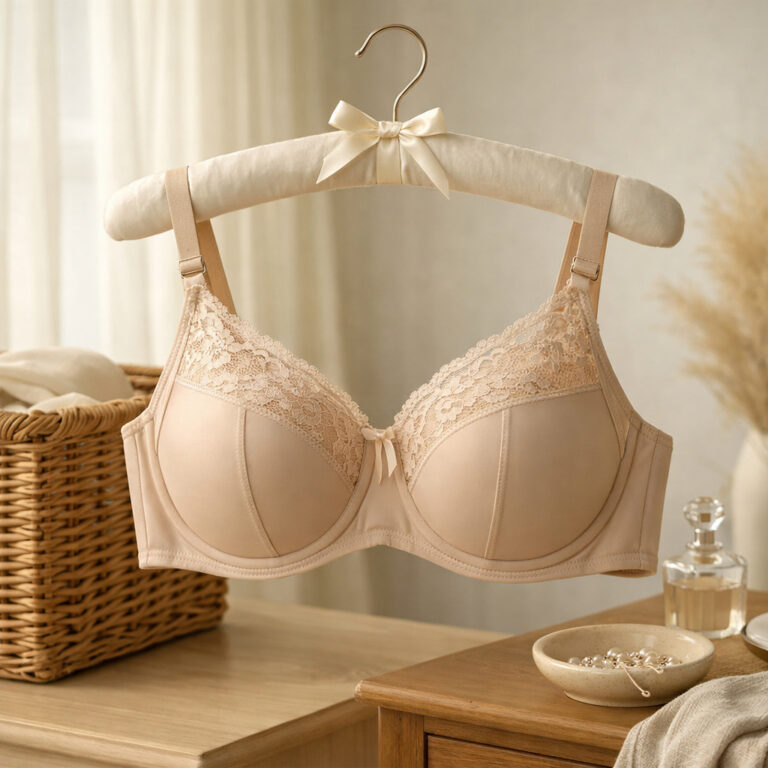
A cup built from several pieces of fabric sewn together has a curve built into it. The seams act like the ribs of an umbrella, holding the shape and lifting from below. The most common patterns are a vertical seam, a horizontal seam, or a three-part cup that combines both. More pieces generally mean more precise shaping, which is why many wireless bras for fuller cup sizes use multi-part cups.
Molded cups
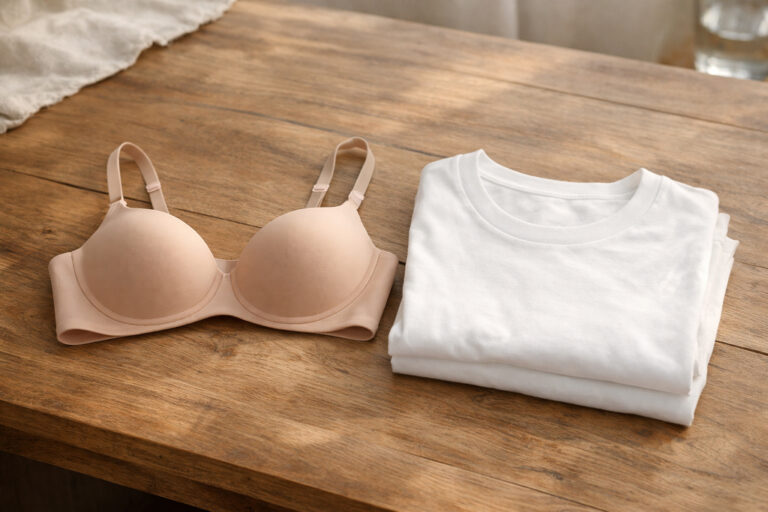
The other route is a molded cup: a single piece of foam or spacer fabric heat-shaped into a curve. Molded wireless cups give a smooth, rounded outline under clothing, and the foam itself provides some structure. They tend to suit smaller and medium cup sizes best, since the foam can only hold so much on its own.
Side slings and side panels
Look inside a well-made wireless bra and you will often see an extra layer of firmer fabric on the outer side of each cup. This side sling or side panel guides tissue forward and toward the center, doing part of what the wire’s outer edge would normally do. Power mesh, a firm stretch net, is a common choice here.
A reinforced center and underband
Some wireless bras add a strip of firm elastic or a stiffened channel under the cups, running across the front. It is not a wire, but it gives the lower edge of the cups a defined line. A wider center panel between the cups also helps with separation.
Strap placement
Straps set closer to the center of the back, or attached at a slight angle, are less likely to slide off the shoulders. Padded or wider straps spread pressure on the shoulder, which matters more when the band is doing extra work and you want everything balanced.
Wireless construction at a glance
| Feature | What it replaces from the wire | What to check |
|---|---|---|
| Deep, firm band | Weight transfer to the body | Stays level when you raise your arms; two or more hook rows |
| Seamed cups | Cup shape and lift from below | Smooth seams that do not press; shape holds when you lean forward |
| Molded cups | Cup shape and a smooth outline | No gaps at the top edge; foam springs back after pressing |
| Side slings or panels | Forward and inward positioning | Firm fabric on the outer cup; no spilling at the sides |
| Reinforced underband | A defined lower edge and separation | Center sits close to your chest rather than floating |
Choosing fabric
Fabric affects comfort and how long the bra holds its shape. A few rules of thumb:
- Cotton blends feel soft and breathable, but pure cotton relaxes with wear. A small percentage of elastane (spandex) helps the fabric recover after stretching.
- Microfiber and nylon blends are smooth under clothing and hold their shape well. They are common in molded and seamless styles.
- Power mesh appears in side panels and bands. It is firm and breathable at the same time, so it supports without trapping much heat.
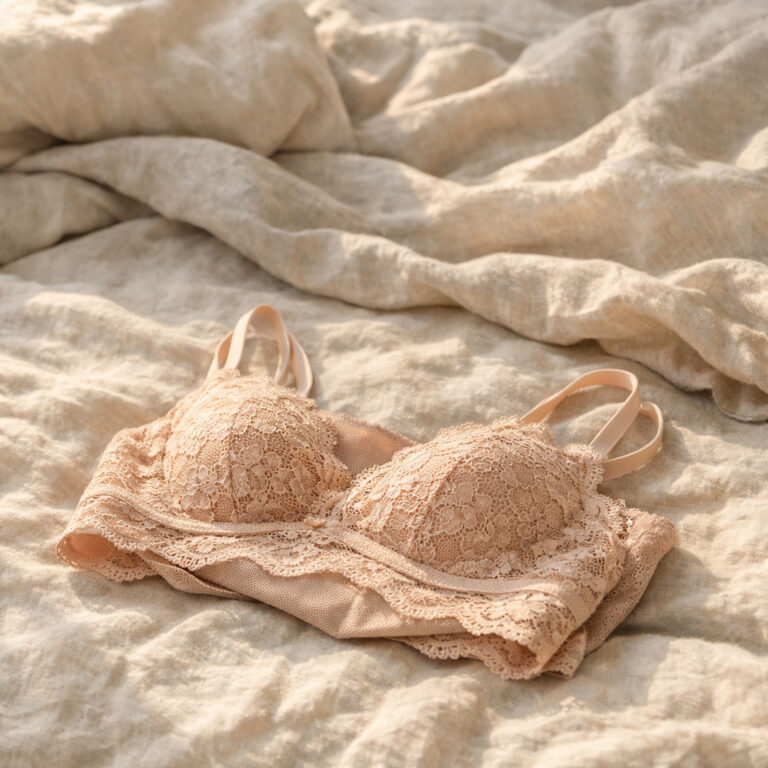
- Lace looks lovely but usually needs a lining or a firm backing to offer real support in a wireless cup.
Turn the bra inside out before you decide. The inside tells you far more than the outside: you can see the lining layers, the side panels and how the seams are finished. Bound or flat seams are less likely to rub than raw edges.
Wireless bra fit checks
Without a wire to anchor things, fit becomes more forgiving in some ways and less in others. A slightly wrong cup size can feel fine for an hour and then rub or sag by the afternoon. These checks help:
- Fasten on the loosest hook. A new band should feel snug on the loosest setting, leaving tighter hooks for when the elastic relaxes.
- Raise both arms. The band should stay put rather than climbing up your back.
- Look at the cups from the side. They should hold you forward with no spilling at the top or sides and no large empty pockets.
- Check the center. Even without a wire, the center panel should sit fairly close to your chest. If it floats far away, the cups may be too small.
- Wear it around the house. If the label and return policy allow, try a new bra at home for an hour before removing the tags.
Wireless bras come in both band-and-cup sizes and letter sizes. Band-and-cup sizing usually gives a more precise fit, especially if you are at the fuller end of the range. If your size feels slightly off, the guide to bra sister sizes explains how moving up or down a band changes the cup volume, and the checklist of signs your bra does not fit works for wired and wireless styles alike.
Who wireless bras suit
Wireless bras are worth trying if wires dig, poke through over time or simply feel like too much on long days. They are also a common choice for travel, working from home and lounging. Plenty of people with fuller busts wear them every day; the key is choosing one with the construction features above instead of the softest option available.
If you are pregnant, nursing, recovering from surgery or dealing with any breast pain, a wire-free style is often more comfortable, but the right choice for your situation is a question for your doctor, midwife or care team.
Wireless bra or bralette?
The two get confused because both skip the wire. The difference is structure. A bralette is a deliberately light garment, often with unlined lace or knit cups and a narrow band. A wireless bra is built more like a conventional bra, with shaped cups, a firm band and side support, just without the metal. If you want comfort first and do not mind little shaping, a bralette may be all you need; the bralette guide covers how they work. If you want a defined shape under fitted clothes, a wireless bra is the better match.
Making a wireless bra last
The elastic in the band is doing most of the work, so it is also the part that wears out first. Rotating between two or three bras gives the elastic time to recover between wears. Washing in cool water and air-drying rather than tumble-drying protects both the elastic and any molded cups. When the band rides up even on the tightest hook, it is time to replace it.
Where to go next
For a smooth option under thin tops, read about t-shirt bras and seamless cups. To keep your wireless bras in shape longer, see the guide on how to wash bras.