The Evolution of Women’s Bras: From Ancient Breast Bands to Modern Designs
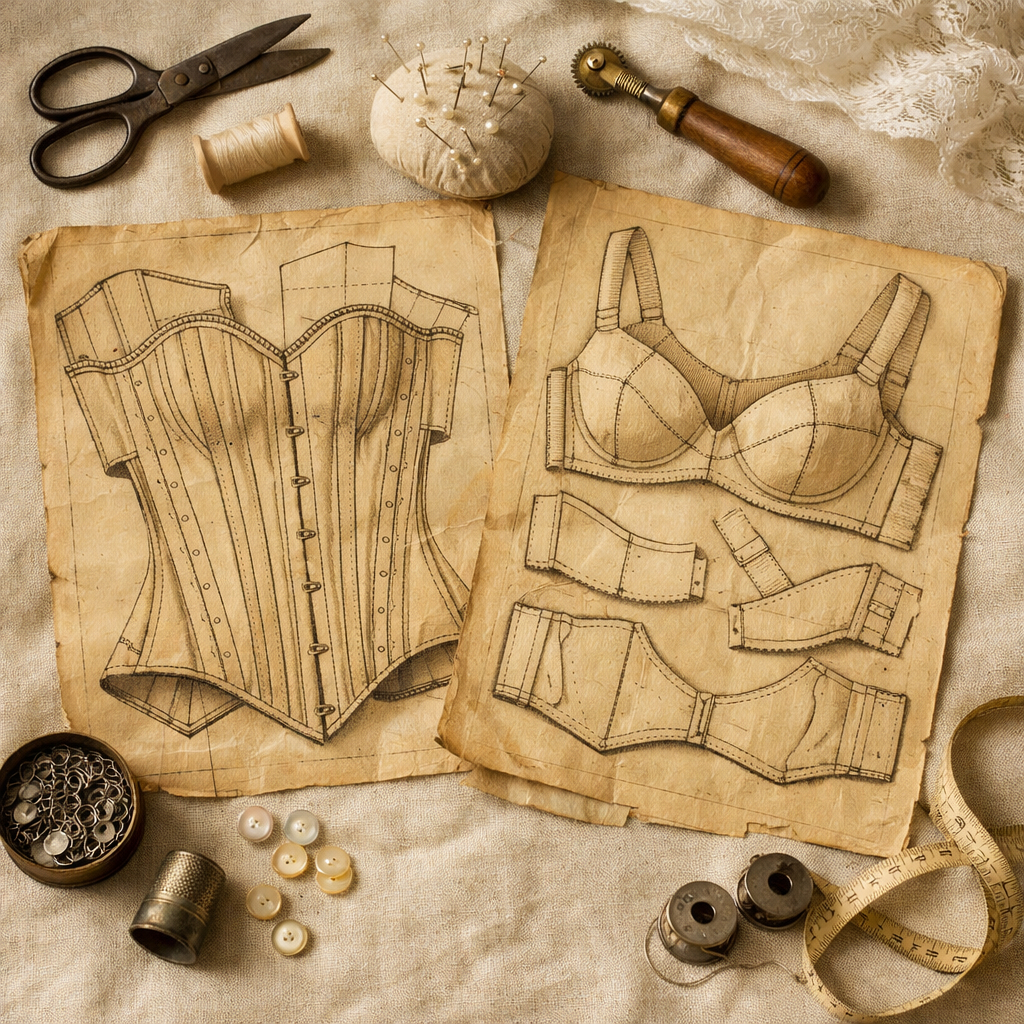
Ask who invented the bra and you will get a confident answer from almost anyone, and very often a different answer each time. A Parisian corsetmaker. A New York debutante with two handkerchiefs. A German engineer named Otto. The truth is less tidy. The history of the bra is a long chain of garments, patents and small design changes stretching back more than two thousand years, and no single person can claim it. This guide follows that chain, sticking to what historians and surviving records actually support, and flagging the stories that do not.
A quick timeline
| Period | Garment or event | What changed |
|---|---|---|
| Ancient Greece | Breast bands (strophion, apodesmos) | Cloth bands wrapped around the chest |
| Roman world | Fascia, mamillare | Bands for support or flattening; shown in a 4th-century CE mosaic |
| 15th century | Linen garments found at Lengberg Castle, Austria | Separate cups, shoulder straps; discovered in 2008 |
| 16th to 19th centuries | Corsets and stays | Torso shaping from waist to chest |
| 1859 to 1893 | U.S. patents for “corset substitutes” and breast supporters | Lighter alternatives to the corset |
| 1889 | Herminie Cadolle’s two-piece corset | Upper part separated from the waist corset |
| 1914 | Mary Phelps Jacob’s “Backless Brassiere” patent | Soft, simple design patented in the U.S. |
| 1930s | Lettered cup sizes | A to D cups standardize fit |
| 1940s | Wartime shortages | Materials diverted to military use |
| 1977 | The jogbra | Purpose-built sports bra |
Ancient breast bands
The earliest garments that can reasonably be called ancestors of the bra are simple bands of cloth. Ancient Greek writers used several words for them, including strophion and apodesmos, for a band of wool or linen wrapped around the upper body. Exactly how each term was used, and how common the garments were in everyday life, is something classicists still debate, since most of the evidence comes from art and literature rather than surviving fabric.
Roman sources add more names, including fascia, taenia and mamillare. Some bands seem to have been worn for support, others to flatten. The best-known visual record is the 4th-century CE “bikini girls” mosaic at the Villa Romana del Casale near Piazza Armerina in Sicily, which shows women taking part in athletic events wearing a band across the chest and a brief lower garment.
The medieval surprise at Lengberg Castle
For a long time, histories jumped straight from Roman bands to the corset. That changed in 2008, when renovation work at Lengberg Castle in East Tyrol, Austria, turned up a filled-in vault containing textile fragments. Among them were four linen garments that look remarkably like modern bras, with separate cups and shoulder straps, and in some cases decorative lace. Radiocarbon dating placed them in the 15th century.
The find matters because it shows that garments with shaped, separate cups existed centuries before the patents that are usually credited with “inventing” the bra. Late medieval writers had mentioned “breast bags,” but there was little physical evidence until Lengberg.
The age of the corset
From around the 16th century, the dominant support garment in Western Europe was the corset, known for much of its history as stays. Built with stiff materials such as whalebone (baleen), and later steel, corsets shaped the whole torso from the waist upward. Styles changed considerably over three centuries, including shorter stays in the late 18th century, but the basic idea of support from a rigid, laced garment held firm into the 1800s.
By the mid-19th century, dress reformers and physicians were questioning tight lacing, and inventors began patenting lighter alternatives. These are often called proto-bras:
- 1859: Henry S. Lesher of Brooklyn patented a breast-supporting garment.
- 1863: Luman L. Chapman of Camden, New Jersey, patented a “corset substitute.”
- 1876: Olivia Flynt received patents for a garment sold as the “True Corset” or “Flynt Waist,” aimed at larger-busted women.
- 1893: Marie Tucek received U.S. patent 494,397 for a breast supporter with separate pockets and shoulder straps, often described as a precursor of the underwire bra.
Herminie Cadolle and the split corset
The French corsetmaker Herminie Cadolle is frequently named as the inventor of the modern bra, and Life magazine once credited her with exactly that. Her garment, known as the corselet-gorge, was shown at the 1889 Exposition Universelle in Paris. It was a two-piece design: a lower corset for the waist and a separate upper piece supported by shoulder straps. By the early 1900s, the upper half was being sold on its own as the soutien-gorge, still the French word for a bra.
The details are less settled than the legend. Accounts differ on where she developed the garment (some place it in Buenos Aires, where she had been living) and on the dates of her patent and even her birth. Whether a corset split in two counts as the “first bra” also depends on how you define the word. Her design is better seen as an important step than as the moment of invention.
The word “brassiere”
The term “brassiere,” borrowed from French, appeared in Vogue in 1907 and was added to the Oxford English Dictionary in 1911. The shortened “bra” became common in the 1930s.
Mary Phelps Jacob’s 1914 patent
The best-known American story belongs to Mary Phelps Jacob, a New York socialite later known as Caresse Crosby. By her own later account, she was dressing for a debutante event, disliked how her corset showed through a sheer gown, and had a maid help her improvise a light garment from two handkerchiefs and ribbon. In November 1914 she was granted U.S. patent 1,115,674 for a “Backless Brassiere.” She later sold the patent to a Connecticut corset company, reportedly for $1,500.
Her patent was real and influential, but she was not the first to patent a bra-like garment, as the earlier patents above show. In Germany, Sigmund Lindauer had begun mass-producing a bra around 1912 and patented it in 1913. Jacob’s story is best understood as one well-documented milestone among several.
A myth worth retiring: Otto Titzling
You may have heard that a man named Otto Titzling invented the bra in Germany. He did not exist. The name comes from a 1971 satirical book, Bust-Up, by Wallace Reyburn, and the joke is in the name. The story was repeated so often that it made its way into trivia games and songs, but there is no historical person behind it.
War, metal and changing materials
World War I helped push corsets aside. In 1917, the U.S. War Industries Board asked women to stop buying corsets to save metal for the war effort. A figure of 28,000 tons of steel saved is frequently quoted, though it is hard to trace to an original source, so treat it as an estimate. Shorter hemlines, more active lives and changing fashions did the rest. By the 1920s, many women were wearing soft bandeau-style bras.
Cup sizes arrive in the 1930s
The idea of a separate cup size, rather than one shape scaled up and down, took hold in the 1930s. In 1932, a manufacturer called S.H. Camp and Company began relating breast size to the letters A to D, and in 1937 another major manufacturer introduced cup sizing to its line. Others followed in the late 1930s. The basic logic of a band number plus a cup letter, explained in the bra size chart guide, dates from these years, even though the exact sizes now vary between countries and makers.
World War II brought shortages of a different kind. Nylon, introduced at the end of the 1930s, was needed for parachutes and other military uses, and many fabrics and metals were rationed. Bras of the period were often made from cotton and rayon, and wartime factory work encouraged practical, sturdy designs.
Post-war shapes and new fibers
The 1950s are remembered for sharply pointed, circle-stitched cups, often called bullet bras. Synthetic fibers became widely available, and in the late 1950s and 1960s stretch fibers such as spandex made lighter, more flexible bands and straps possible. Many of the bra styles people wear today, including padded, plunge and molded designs, developed through these decades.
One more correction to popular memory: the 1968 protest at the Miss America pageant in Atlantic City is often described as a “bra burning.” Participants threw bras and other items into a trash can, but those involved have said nothing was set on fire.
The sports bra, 1977
Commercial athletic bras existed before the late 1970s, but the most famous origin story is well documented. In 1977 in Vermont, Lisa Lindahl, a new runner frustrated by her everyday bras, worked with costume designers Polly Smith and Hinda Miller (then Hinda Schreiber) on something better. Their prototype was famously made from two athletic supporters sewn together. First called the “jockbra,” it was renamed the jogbra, patented, and sold through a company the founders started in 1979. All three were inducted into the National Inventors Hall of Fame in 2022. The compression design they popularized is still the basis of many sports bras; the sports bra guide explains how it compares to encapsulation styles.
What the history tells us
Looking back, the bra was never one invention. It was a slow shift from bands to rigid shaping and back toward lighter, adjustable support, driven by fashion, war, new materials and the everyday needs of the people wearing them. The most persistent myths are about single inventors, and the evidence points the other way: many people, across many centuries, each solving part of the problem.
Where to go next
To see how today’s designs compare, read the guide to types of bras, or explore more in Care & History.