How to Store Bras So Molded Cups Keep Their Shape
For years my bras lived in a jumble at the back of a dresser drawer, one cup tucked inside the other, straps wound around everything, hooks snagging on whatever was nearby. Every morning I would pull one out and smooth a dent out of a molded cup with my thumb. Eventually some dents stopped smoothing out. Learning how to store bras properly turned out to be one of the cheapest things I have done to make them last, and it took about twenty minutes to reorganize the drawer.
Why storage matters more than you would think
Most of a bra’s life is spent not being worn. It sits in a drawer, a basket or a suitcase, and during that time it is either holding its shape or being slowly pressed out of it. The main things storage can damage are:
- Molded and foam cups, which can crease or dent permanently if folded or crushed under other clothes.
- Underwires, which can bend if the bra is folded in half or squashed.
- Straps and elastic, which can be stretched if a bra hangs by its straps for long periods.
- Lace and mesh, which get snagged by open hooks on neighboring bras.
Good storage avoids all four with a few simple habits.
The basic rule: never fold one cup into the other
This is the most common storage habit, and the one that does the most harm to molded cups. Pushing one cup inside out into the other bends the cup against its shape and leaves a crease along the middle. Over time that crease shows through thin tops, which defeats the purpose of a smooth cup.
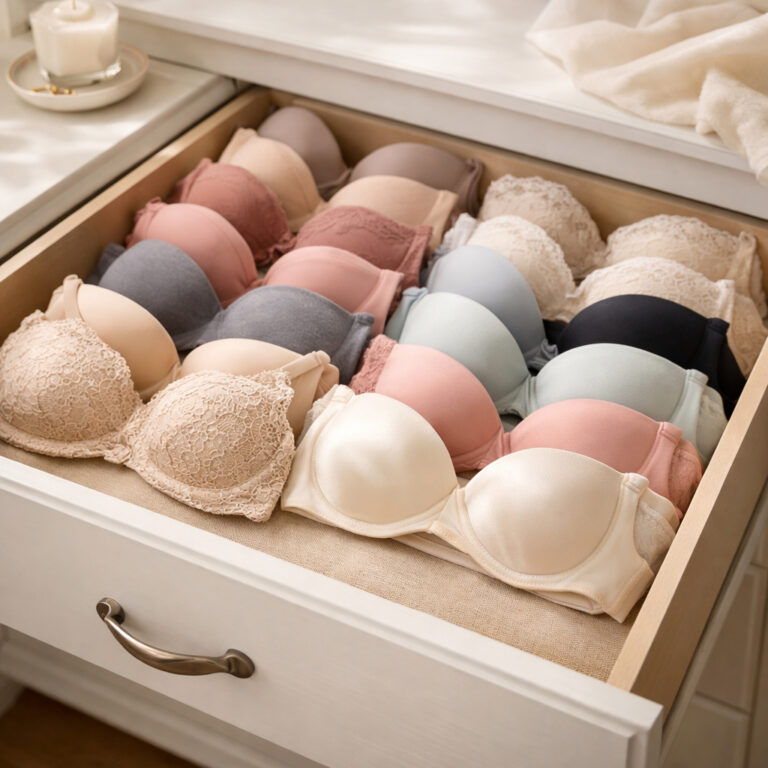
Instead, nest bras. Place one bra flat with its cups facing up, then lay the next one directly on top so its cups sit inside the cups of the first. Both keep their natural curve, and they take up only a little more space than one bra alone.
How to store bras in a drawer
A drawer is the most practical home for most bras, as long as they have enough room. Here is how I set mine up:
- Give bras their own drawer or section. Mixing them with socks and heavier clothes means something will be piled on top of the cups.
- Fasten the hooks on each bra before putting it away, so open hooks cannot catch on lace or mesh.
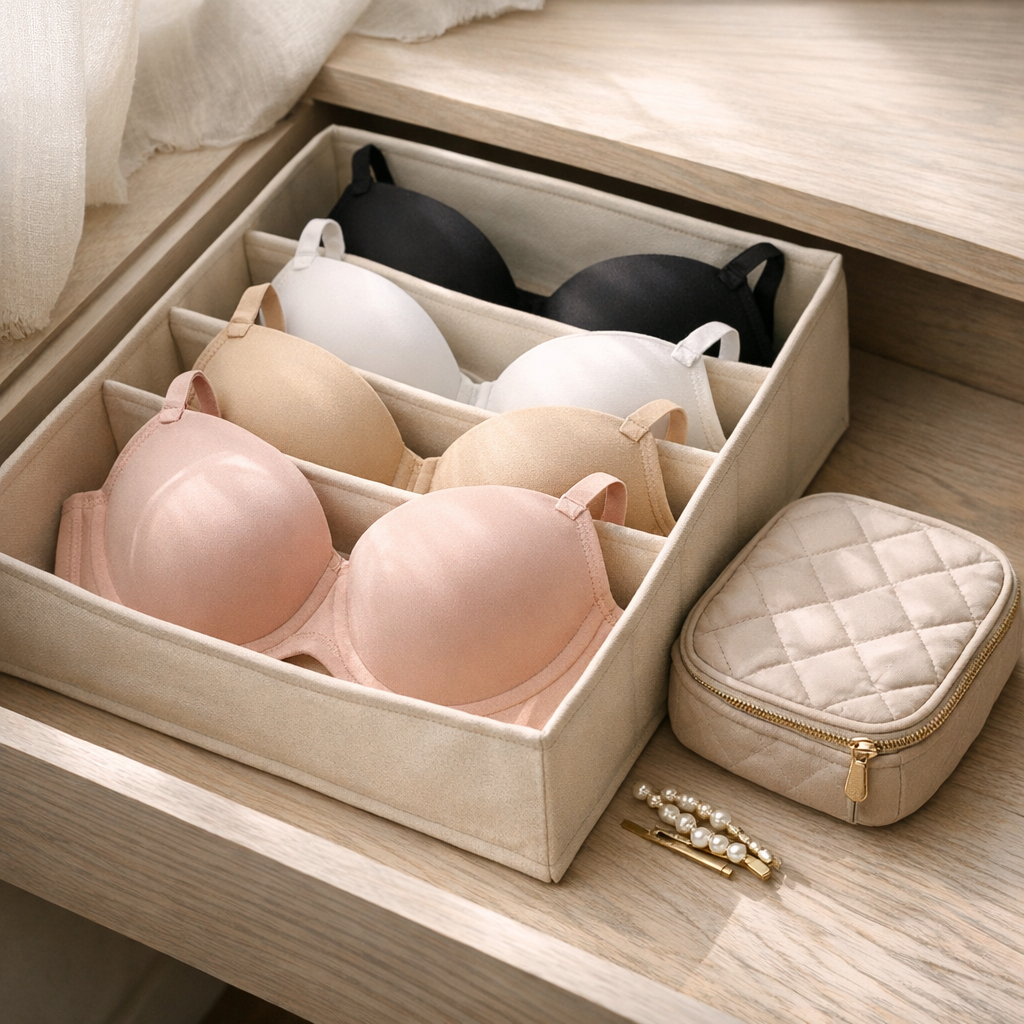
- Nest molded bras in a row, front to back, like a line of stacked bowls. Keep the stacks fairly short so the bottom bra is not compressed.
- Tuck the straps and band into the cup of the top bra in each stack, or let them lie flat behind it. Do not wind them around the cups.
- Store soft bras separately. Wireless, unlined and bralette styles can be folded gently in half along the center, since they have no molded shape to lose.
A drawer divider or organizer with long compartments makes this easier, but a shoebox lid or a couple of small boxes inside the drawer does the same job.
Can you hang bras?
Hanging can work, with one caution: avoid hanging bras by the straps for long stretches. The weight of the bra pulls on the strap elastic constantly, and it can stretch over time. If you want to hang bras, drape them over a hanger bar by the center gore, the small panel between the cups, or use a hanger with clips that hold the band. Some people use a dedicated lingerie hanger or a row of hooks inside a closet door. Hanging is especially useful for bras with molded cups if your drawers are crowded, since nothing is pressing on the cups.
Storage by bra style
| Bra style | Best storage | Avoid |
|---|---|---|
| Molded or T-shirt bra | Nested in a row, cups up | Folding one cup into the other |
| Unlined underwire | Nested or laid flat | Folding across the wire |
| Wireless or bralette | Folded gently in half, stacked | Crushing under heavy clothes |
| Strapless | Laid flat or nested, straps removed and stored with it | Rolling tightly, which kinks boning |
| Sports bra | Folded or rolled | Storing before fully dry |
| Lace or delicate | Flat, hooks fastened, away from rough fabrics | Loose in a mixed drawer |
Detachable straps from strapless and convertible bras go missing easily. Clipping them to the bra’s band, or keeping them in a small pouch in the same compartment, saves a lot of searching.
How to pack bras for travel
Suitcases are where molded cups get crushed most often, because everything is compressed. A few habits help:
- Nest them exactly as you would in a drawer.
- Fill the cups. Rolled socks or underwear tucked into the cups of the top bra act as support and use space that would otherwise be wasted.
- Use a pouch or small case. A soft zippered pouch, a packing cube or a hard-sided bra case keeps the stack together and stops other items pressing on it.
- Pack them on top or along the edge of the suitcase, not under shoes and toiletries.
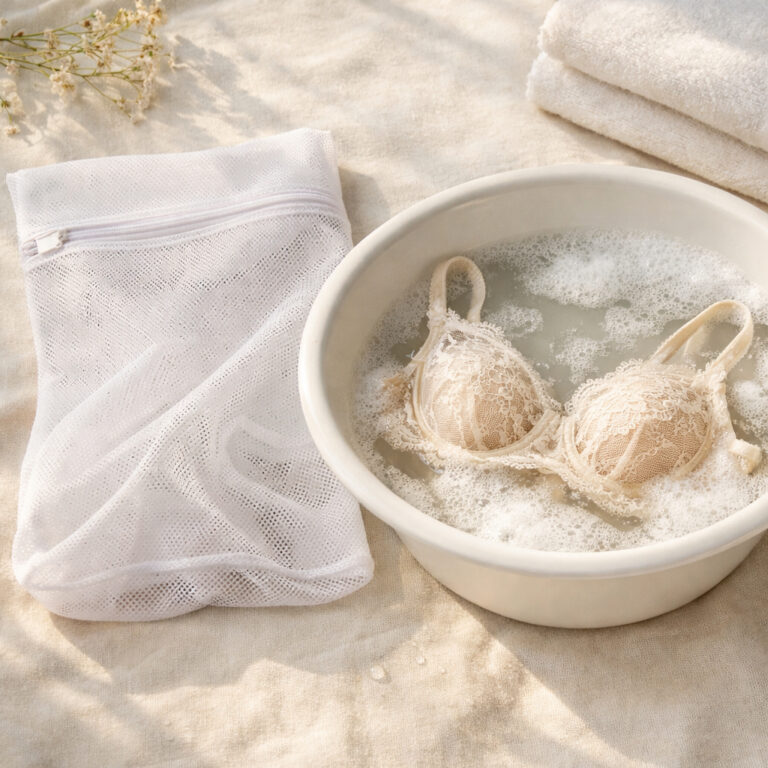
- Bring a mesh laundry bag if you will be washing on the road. It doubles as a place to keep worn bras separate.
Sports bras and soft wireless styles are the easiest to travel with, since they can be rolled tightly without harm.
Seasonal and long-term storage
Some bras only come out occasionally: a strapless one for summer events, nursing bras between babies, a sports bra for a seasonal activity. For storage over months rather than days:
- Wash before storing. Body oils and deodorant residue left in the fabric can discolor it over time. Use the gentle method in how to wash bras.
- Make sure everything is completely dry. Storing damp fabric invites musty smells and mildew.
- Choose a breathable container. A cotton storage bag or a box lined with clean cotton fabric lets air circulate. Sealed plastic can trap moisture.
- Keep it somewhere cool, dry and dark. Heat is hard on elastic, and strong light can fade colors. Attics and spaces next to heaters are not ideal.
- Keep the cups supported with the nesting method, or a little acid-free tissue paper inside the cups.
Be aware that elastic ages even when it is not being worn. A bra stored for a long time may feel less firm than you remember, so check the band before relying on it for an important occasion.
Storing nursing, maternity and sentimental bras
Nursing and maternity bras are often put away for a year or more between children, which makes them the bras most likely to be stored badly. Clean them first, paying attention to any milk residue around the cups, which can yellow over time if left in the fabric. Close the nursing clips so they are not under strain, and store the bras flat with soft cups folded gently or nested if they are molded. When you take them out again, check the elastic and the clips before relying on them, because sizes often change between pregnancies too.
Older bras kept for sentimental reasons, such as one from a wedding, do best treated like any other delicate textile: clean, fully dry, wrapped in clean cotton or acid-free tissue, and stored flat in a box away from heat and light.
A few small habits that add up
- Let a bra air out before putting it away. If you have worn it for a day, leaving it out for a few hours lets moisture evaporate before it goes into a closed drawer.
- Rotate the stack. Put the bra you just washed at the back so you are not always wearing the same one. Rotation gives elastic time to recover, which matters for how often you will need to replace bras.
- Clear out what you do not wear. A packed drawer crushes everything in it. Bras that no longer fit can go, which gives the rest room to breathe.
- Keep a small repair kit nearby. A needle, matching thread and a few spare hooks make quick fixes easy before small problems turn into big ones.
The short version
Nest molded bras with the cups facing the same way, fasten the hooks, avoid hanging by the straps, protect cups in a suitcase, and store everything clean and dry. None of it takes more than a few seconds a day, and it keeps cups smooth and elastic in good shape for far longer.
Where to go next
For the other half of good care, read how to wash bras without ruining them, or browse the full Care & History section.