How to Measure Bra Size at Home: Band, Bust and the Math
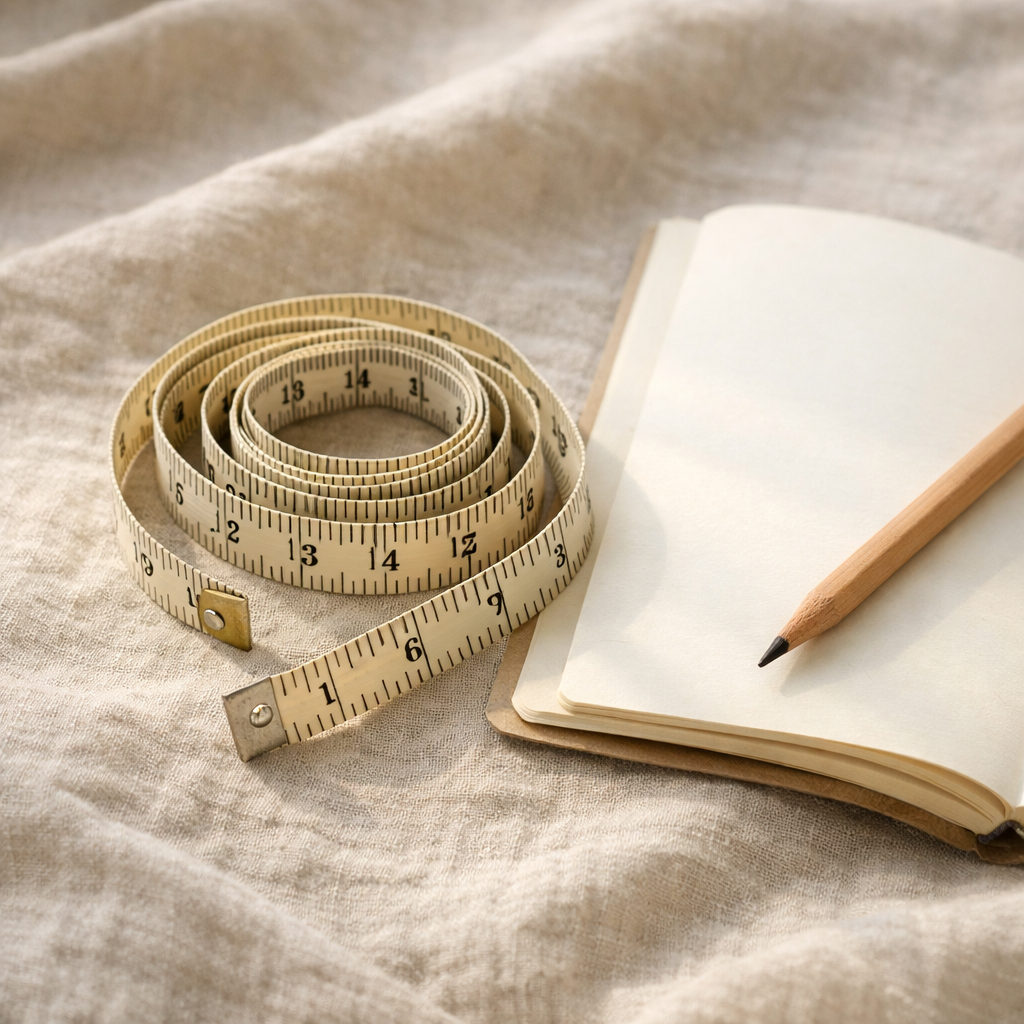
You have a soft tape measure, a mirror and ten minutes. That is genuinely all it takes to learn how to measure bra size at home, and the measuring itself is the easy part. The confusing part comes afterward, when two websites turn the same two numbers into two different sizes. This guide walks through the measurements slowly, explains the arithmetic, and then spends some time on why the methods disagree, because once you understand that, the number stops being a verdict and becomes what it really is: a sensible place to start trying things on.
A quick word about where I am coming from. I am not a professional fitter. I sew, I alter, and I have unpicked enough bras to know how the band, cups and wires are put together. What follows is the method I use and the reasoning behind it.
What you need before you start
- A soft, flexible tape measure. The fabric or plastic kind used for sewing, not a metal tape from the toolbox. If the numbers have worn off, replace it; a stretched tape gives you a stretched answer.
- A mirror, so you can check the tape is level across your back. A second mirror or a helper makes this much easier.
- A thin, unpadded bra or no bra. Padding and molded cups add to the bust measurement. If you measure in a bra, choose the thinnest, least structured one you own.
- Something to write on, because you will measure more than once.
Stand up straight but relaxed, arms down at your sides, and breathe normally. Holding your breath in or pushing your ribs out changes the band number more than people expect.
Step 1: The band (underbust) measurement
Wrap the tape around your ribcage directly underneath your bust, where the bottom edge of a bra band would sit. Check in the mirror that it is level all the way around, not sloping up across your back, which is the most common mistake.
Pull the tape snug. It should feel firm against your skin, the way a well-fitting band feels, but not so tight that it digs in or makes breathing awkward. Read the number in inches and write it down. Do it two or three times; if the readings differ, use the one that came up most often.
If you land between whole numbers, round to the nearest inch. Bra bands are sold in even numbers in the US (30, 32, 34, 36 and so on), so an odd measurement such as 33 inches means you will be choosing between a 32 and a 34. Neither choice is wrong, and trying both is the honest answer. The band does most of the supporting work in a bra, which is why this first number matters more than the second.
Step 2: The bust measurement
Now wrap the tape around the fullest part of your bust, usually level with the nipples. This time the tape should rest lightly. Do not pull it tight, and do not let it droop at the back. Again, check the mirror for a level line.
Many fitters suggest taking this measurement twice: once standing upright, and once leaning forward at the hips so your torso is roughly parallel to the floor, letting the tape hang loosely around you. If the two readings are close, use the standing one. If the leaning measurement is noticeably larger, that tells you the cups need more room than the upright number suggests, and it is worth leaning toward the larger figure when you do the math.
Step 3: The math
The cup size comes from the difference between the bust and the band. In the common US approach, each inch of difference is one cup size:
| Bust minus band | US cup |
|---|---|
| Less than 1 inch | AA |
| 1 inch | A |
| 2 inches | B |
| 3 inches | C |
| 4 inches | D |
| 5 inches | DD (also labeled E) |
| 6 inches | DDD (also labeled F) |
A worked example: your snug underbust is 33 inches, which you round to a 34 band. Your bust measures 38 inches. The difference is 4 inches, so the math gives you 34D. If you also try a 32 band, remember that the cup letter has to move up to keep the same cup volume, which is the idea behind sister sizes.
Past DDD, US labeling stops being consistent from one maker to the next, and UK sizing, which uses its own letter sequence, becomes the more common system for larger cups. I cover the letter sequences side by side in the bra size chart guide, so I will not repeat them here.
Why different methods give different sizes
If you have ever put your numbers into two calculators and got two answers, this is usually why.
The “+4” band rule versus measuring snug
An older and still widely circulated method does not use your underbust number as the band. Instead it tells you to add 4 inches to the underbust (often 5 if the measurement is odd) and use that as the band size. Under that rule, the 33-inch underbust in the example above becomes a 38 band, not a 34.
That shift has a knock-on effect on the cup. Because the cup is calculated from the gap between bust and band, a band that has been inflated by 4 inches leaves a smaller gap, so the cup letter comes out smaller. The same person who measured 34D by the snug method gets 38A by the +4 method. Those two sizes are not interchangeable: the second has a much looser band and a cup shaped for a different frame.
You will see explanations for where the +4 rule came from, most often that it dates from a time when band fabrics stretched less than they do now. I have not found a reliable source that settles the origin, so I would treat that story as plausible rather than proven. What is easy to observe is the result: many people who switch from a +4 size to a snug-measured size find the band finally stays put and the straps stop doing all the work. Many fitting guides today measure snug and use the number as is, or add very little.
Inches, centimeters and cup steps
The US and UK both work in inches, with roughly one inch of bust-to-band difference per cup. European sizing works in centimeters, with bands in 5 cm steps and cups in steps of about 2 cm. Since an inch is 2.54 cm, the systems line up closely at small sizes and drift apart as the difference grows, which is one reason a conversion chart is a guide rather than an exact translation.
Brands and styles
Even within one country, each maker uses its own patterns, its own band elastic and its own cup shapes. A plunge and a full-coverage style from the same company can fit differently in the same labeled size. The tape measures your body; it cannot measure the bra.
Common measuring mistakes
- A sloping tape. If the tape rides up at the back, the band reading will be off. Use the mirror every time.
- Measuring over padding. A molded or padded bra can add an inch or more to the bust measurement, which inflates the cup.
- Pulling the bust tape tight. The bust measurement should be relaxed. Only the band reading is snug.
- Measuring once. Take each measurement at least twice. Small differences of half an inch are normal.
- Measuring at an unusual time. Many people notice their size changes a little across the month, after weight changes, during pregnancy and after. If you are measuring during one of those times, expect the number to move later.
Your number is a starting point, not a verdict
Here is the part that most guides on how to measure bra size skip. The tape gives you a first size to pull off the rail. The bra itself tells you whether it is right. When you try one on:
- Fasten it on the loosest hook. Bands loosen with wear, and the tighter hooks are there for later.
- Lean forward and settle each side into the cup, then stand up and adjust the straps.
- Check that the band sits level around your body and feels firm without pinching.
- Look at the cup edges and the center panel between the cups to see whether they lie smoothly.
If something is off, change one thing at a time: the band size, the cup letter or the style. The detailed checks for each part of the bra, and what each problem usually means, are in my guide to the signs your bra does not fit.
When to measure again
There is no fixed schedule, but it is worth re-measuring when your bras start feeling different, after a noticeable change in weight, after pregnancy or breastfeeding, or simply if it has been a few years. It takes ten minutes, and it is much cheaper than buying a drawer full of bras in a size you have outgrown.
And if anything about fit comes with pain, rather than ordinary discomfort from a poor fit, that is a question for a doctor rather than a tape measure.
Where to go next
To translate your number between US, UK, EU and Australian labels, read the bra size chart explained. For more on band, cup and fit, browse the Sizing & Fit section.